Charles Darwin
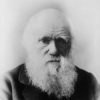
Charles Darwin
Charles Robert Darwin, FRS FRGS FLS FZSwas an English naturalist and geologist, best known for his contributions to the science of evolution. He established that all species of life have descended over time from common ancestors, and in a joint publication with Alfred Russel Wallace introduced his scientific theory that this branching pattern of evolution resulted from a process that he called natural selection, in which the struggle for existence has a similar effect to the artificial selection involved in...
ProfessionScientist
Date of Birth12 February 1809
CityShrewsbury, England
The impossibility of conceiving that this grand and wondrous universe, with our conscious selves, arose through chance, seems to me the chief argument for the existence of God.
Believing as I do that man in the distant future will be a far more perfect creature than he now is, it is an intolerable thought that he and all other sentient beings are doomed to complete annihilation after such long-continued slow progress.
...he who remains passive when over-whelmed with grief loses his best chance of recovering his elasticity of mind.
I cannot persuade myself that a beneficent and omnipotent God would have designedly created parasitic wasps with the express intention of their feeding within the living bodies of Caterpillars.
Man scans with scrupulous care the character and pedigree of his horses, cattle, and dogs before he matches them; but when he comes to his own marriage he rarely, or never, takes any such care.
As for a future life, every man must judge for himself between conflicting vague probabilities.
Not one great country can be named, from the polar regions in the north to New Zealand in the south, in which the aborigines do not tattoo themselves.
Nature will tell you a direct lie if she can.
Besides love and sympathy, animals exhibit other qualities connected with the social instincts which in us would be called moral.
To suppose that the eye with all its inimitable contrivances for adjusting the focus to different distances, for admitting different amounts of light, and for the correction of spherical and chromatic aberration, could have been formed by natural selection, seems, I confess, absurd in the highest degree...The difficulty of believing that a perfect and complex eye could be formed by natural selection , though insuperable by our imagination, should not be considered subversive of the theory.
But Geology carries the day: it is like the pleasure of gambling, speculating, on first arriving, what the rocks may be; I often mentally cry out 3 to 1 Tertiary against primitive; but the latter have hitherto won all the bets.
Even when we are quite alone, how often do we think with pleasure or pain of what others think of us - of their imagined approbation or disapprobation.
Nothing is easier than to admit in words the truth of the universal struggle for life, or more difficult--at least I have found it so--than constantly to bear this conclusion in mind.
...all nature is perverse & will not do as I wish it.