Charles Darwin
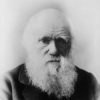
Charles Darwin
Charles Robert Darwin, FRS FRGS FLS FZSwas an English naturalist and geologist, best known for his contributions to the science of evolution. He established that all species of life have descended over time from common ancestors, and in a joint publication with Alfred Russel Wallace introduced his scientific theory that this branching pattern of evolution resulted from a process that he called natural selection, in which the struggle for existence has a similar effect to the artificial selection involved in...
ProfessionScientist
Date of Birth12 February 1809
CityShrewsbury, England
When primeval man first used flint stones for any purpose, he would have accidentally splintered them, and would then have used the sharp fragments. From this step it would be a small one to break the flints on purpose and not a very wide step to fashion them rudely.
I ought, or I ought not, constitute the whole of morality.
The season of love is that of battle. The roots of these fights run deep.
From my early youth I have had the strongest desire to understand or explain whatever I observed. ... To group all facts under some general laws.
The survival or preservation of certain favoured words in the struggle for existence is natural selection.
Whoever is led to believe that species are mutable will do good service by conscientiously expressing his conviction; for only thus can the load of prejudice by which this subject is overwhelmed be removed.
I have long discovered that geologists never read each other's works, and that the only object in writing a book is a proof of earnestness.
In my most extreme fluctuations I have never been an atheist in the sense of denying the existence of a God ... I think that generally (& more and more so as I grow older) but not always, that an agnostic would be the most correct description of my state of mind.
The man that created the theory of evolution by natural selection was thrown out by his Dad because he wanted him to be a doctor. GAWD, parents haven't changed much.
The age-old and noble thought of 'I will lay down my life to save another,' is nothing more than cowardice.
It is not the strongest of the species that survives, nor the most intelligent that survives. It is the one that is the most adaptable to change, that lives within the means available and works co-operatively against common threats.
It's not the strongest, but the most adaptable that survive.
After my return to England it appeared to me that by following the example of Lyell in Geology, and by collecting all facts which bore in any way on the variation of animals and plants under domestication and nature, some light might perhaps be thrown on the whole subject.
It is so easy to hide our ignorance under such expressions as the plan of creation or unity of design, etc., and to think that we give an explanation when we only restate a fact.