Charles Darwin
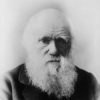
Charles Darwin
Charles Robert Darwin, FRS FRGS FLS FZSwas an English naturalist and geologist, best known for his contributions to the science of evolution. He established that all species of life have descended over time from common ancestors, and in a joint publication with Alfred Russel Wallace introduced his scientific theory that this branching pattern of evolution resulted from a process that he called natural selection, in which the struggle for existence has a similar effect to the artificial selection involved in...
ProfessionScientist
Date of Birth12 February 1809
CityShrewsbury, England
Many kinds of monkeys have a strong taste for tea, coffee and spirituous liqueurs.
If Mozart, instead of playing the pianoforte at three years old with wonderfully little practice, had played a tune with no practice at all, he might truly have been said to have done so instinctively.
Describing laughter: The sound is produced by a deep inspiration followed by short, interrupted, spasmodic contractions of the chest, and especially the diaphragm... the mouth is open more or less widely, with the corners drawn much backwards, as well as a little upwards; and the upper lip is somewhat raised.
Man is more courageous, pugnacious, and energetic than woman, and has a more inventive genius. His brain is absolutely larger, butwhether or not proportionally to his larger body, has not, I believe, been fully ascertained. In woman the face is rounder; the jaws and the base of skull smaller; the outlines of the body rounder, in parts more prominent; and her pelvis is broader than in man; but this latter character may perhaps be considered rather as a primary than a secondary sexual character. She comes to maturity at an earlier age than man.
Daily it is forced home on the mind of the biologist that nothing, not even the wind that blows, is so unstable as the level of the crust of this earth.
When the views entertained in this volume on the origin of species, or when analogous views are generally admitted, we can dimly forsee that there will be a considerable revolution in natural history.
One hand has surely worked throughout the universe.
A scientific man ought to have no wishes, no affections, - a mere heart of stone.
A grand and almost untrodden field of inquiry will be opened, on the causes and laws of variation, on correlation of growth, on the effects of use and disuse, on the direct actions of external conditions, and so forth.
Endless forms most beautiful and most wonderful have been, and are being evolved
The limit of man s knowledge in any subject possesses a high interest which is perhaps increased by its close neighbourhood to the realms of imagination.
Linnaeus and Cuvier have been my two gods, though in very different ways, but they were mere schoolboys to old Aristotle.
There is no fundamental difference between humans and the higher mammalsin their mental faculties
Disbelief crept over me at a very slow rate, but at last it was complete.