Blaise Pascal
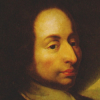
Blaise Pascal
Blaise Pascalwas a French mathematician, physicist, inventor, writer and Christian philosopher. He was a child prodigy who was educated by his father, a tax collector in Rouen. Pascal's earliest work was in the natural and applied sciences where he made important contributions to the study of fluids, and clarified the concepts of pressure and vacuum by generalising the work of Evangelista Torricelli. Pascal also wrote in defence of the scientific method...
NationalityFrench
ProfessionPhilosopher
Date of Birth19 June 1623
CityClermont-Ferrand, France
CountryFrance
A jester, a bad character.
Atheism shows strength of mind, but only to a certain degree.
There are some who speak well and write badly. For the place and the audience warm them, and draw from their minds more than they think of without that warmth.
Our soul is cast into a body, where it finds number, time, dimension. Thereupon it reasons, and calls this nature necessity, and can believe nothing else.
Habit is a second nature that destroys the first. But what is nature? Why is habit not natural? I am very much afraid that nature itself is only a first habit, just as habit is a second nature.
The last proceeding of reason is to recognize that there is an infinity of things which are beyond it. There is nothing so conformable to reason as this disavowal of reason.
We have an idea of truth, invincible to all scepticism.
There would be too great darkness, if truth had not visible signs.
All mankind's unhappiness derives from one thing: his inability to know how to remain in repose in one room.
Necessity, that great refuge and excuse for human frailty, breaks through all law; and he is not to be accounted in fault whose crime is not the effect of choice, but force.
The finite is annihilated in the presence of the infinite, and becomes a pure nothing. So our spirit before God, so our justice before divine justice.
We are usually convinced more easily by reasons we have found ourselves than by those which have occurred to others.
Amusement allures and deceives us and leads us down imperceptibly in thoughtlessness to the grave
Two similar faces, neither of which alone causes laughter, use laughter when they are together, by their resemblance.