Blaise Pascal
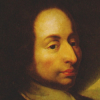
Blaise Pascal
Blaise Pascalwas a French mathematician, physicist, inventor, writer and Christian philosopher. He was a child prodigy who was educated by his father, a tax collector in Rouen. Pascal's earliest work was in the natural and applied sciences where he made important contributions to the study of fluids, and clarified the concepts of pressure and vacuum by generalising the work of Evangelista Torricelli. Pascal also wrote in defence of the scientific method...
NationalityFrench
ProfessionPhilosopher
Date of Birth19 June 1623
CityClermont-Ferrand, France
CountryFrance
It is not only old and early impressions that deceive us; the charms of novelty have the same power.
As men are not able to fight against death, misery, ignorance, they have taken it into their heads, in order to be happy, not to think of them at all.
We run carelessly to the precipice, after we have put something before us to prevent us seeing it.
Nature confuses the skeptics and reason confutes the dogmatists
All the maxims have been written. It only remains to put them into practice.
If we must not act save on a certainty, we ought not to act on religion, for it is not certain. But how many things we do on an uncertainty, sea voyages, battles!
Human life is thus only an endless illusion. Men deceive and flatter each other. No one speaks of us in our presence as he does when we are gone. Society is based on mutual hypocrisy.
A town, a landscape are when seen from afar a town and a landscape; but as one gets nearer, there are houses, trees, tiles leaves, grasses, ants, legs of ants and so on to infinity. All this is subsumed under the name of landscape.
How I hate this folly of not believing in the Eucharist, etc.! If the gospel be true, if Jesus Christ be God, what difficulty is there?
Fire. God of Abraham, God of Isaac, God of Jacob, not of the philosophers and the scholars. I will not forget thy word. Amen.
If we submit everything to reason our religion will be left with nothing mysterious or supernatural. If we offend the principles of reason our religion will be absurd and ridiculous . . . There are two equally dangerous extremes: to exclude reason, to admit nothing but reason.
Just as I do not know where I came from, so I do not know where I am going. All I know is that when I leave this world I shall fall forever into oblivion, or into the hands of an angry God, without knowing which of the two will be my lot for eternity. Such is my state of mind, full of weakness and uncertainty. The only conclusion I can draw from all this is that I must pass my days without a thought of trying to find out what is going to happen to me.
Everything that is written merely to please the author is worthless.
If they [Plato and Aristotle] wrote about politics it was as if to lay down rules for a madhouse. And if they pretended to treat it as something really important it was because they knew that the madmen they were talking to believed themselves to be kings and emperors. They humored these beliefs in order to calm down their madness with as little harm as possible.