Bertrand Russell
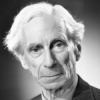
Bertrand Russell
Bertrand Arthur William Russell, 3rd Earl Russell, OM, FRSwas a British philosopher, logician, mathematician, historian, writer, social critic, political activist and Nobel laureate. At various points in his life he considered himself a liberal, a socialist, and a pacifist, but he also admitted that he had "never been any of these things, in any profound sense". He was born in Monmouthshire into one of the most prominent aristocratic families in the United Kingdom...
NationalityBritish
ProfessionPhilosopher
Date of Birth18 May 1872
The Axiom of Choice is necessary to select a set from an infinite number of socks, but not an infinite number of shoes.
I never held Negroes to be inherently inferior. The statement in Marriage and Morals refers to environmental conditioning. I have had it withdrawn from subsequent editions because it is clearly ambiguous.
The use of force stands in need of control by a public neutral authority, in the interests of liberty no less than of justice. Within a nation, this public authority will naturally be the state; in relations between nations, if the present anarchy is to cease, it will have to be some international parliament.
Into every tidy scheme for arranging the pattern of human life, it is necessary to inject a certain dose of anarchism.
The time has come, or is about to come, when only large-scale civil disobedience, which should be nonviolent, can save the populations from the universal death which their governments are preparing for them.
The chicken noticed that the farmer came every day to feed it. It predicted that the farmer would continue to bring food every day. Inductivists think that the chicken had "extrapolated" its observations into a theory, and that each feeding time added justification to that theory. Then one day the farmer came and wrung the chicken's neck. This inductively justifies the conclusion that induction cannot justify any conclusion.
It is obviously possible that what we call waking life may only be an unusual and persistent nightmare.
Even if it is indifferent to human desires, as it seems to be; if human life is a passing episode, hardly noticeable in the vastness of cosmic processes; if there is no superhuman purpose, and no hope of ultimate salvation, it is better to know and acknowledge this truth than to endeavor, in futile self-assertion, to order the universe to be what we find comfortable.
Protagoras did not know if the gods exist, but he held in any case they ought to be worshiped. Philosophy, according to him, had nothing edifying to teach, and for the survival of morals we must rely upon the thoughtlessness of the majority and their willingness to believe what they had been taught.
One of the most painful circumstances of recent advances in science is that each one makes us know less than we thought we did
In view of the fact that in any future world war nuclear weapons will certainly be employed, and that such weapons threaten the continued existence of mankind, we urge the governments of the world to realize, and to acknowledge publicly, that their purpose cannot be furthered by a world war, and we urge them, consequently, to find peaceful means for the settlement of all matters of dispute between them.
Americans and Englishmen, when they become acquainted with the Balkans, feel an astonished contempt when they study the mutual enmities of Bulgarians and Serbs, of Hungarians and Rumanians. It is evident to them that these enmities are absurd and that the belief of each little nation in its own superiority has no objective basis. But most of them are quite unable to see that the national pride of a Great Power is essentially as unjustifiable as that of a little Balkan country.
Every sane and sensible and quiet thing we do is absolutely ignored by the press.
It would have been very much better for the world if Britain had remained neutral and the Germans had won a quick victory. We should not have had either the Nazis or the Communists if that had happened.