Soren Kierkegaard
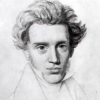
Soren Kierkegaard
Søren Aabye Kierkegaard; 5 May 1813 – 11 November 1855) was a Danish philosopher, theologian, poet, social critic and religious author who is widely considered to be the first existentialist philosopher. He wrote critical texts on organized religion, Christendom, morality, ethics, psychology, and the philosophy of religion, displaying a fondness for metaphor, irony and parables. Much of his philosophical work deals with the issues of how one lives as a "single individual", giving priority to concrete human reality over abstract thinking...
NationalityDanish
ProfessionPhilosopher
Date of Birth5 May 1813
CityCopenhagen, Denmark
CountryDenmark
Soren Kierkegaard quotes about
The more one suffers, the more, I believe, has one a sense for the comic. It is only by the deepest suffering that one acquires true authority in the use of the comic, an authority which by one word transforms as by magic the reasonable creature one calls man into a caricature.
Spirit is the third, yet in such a way that one can speak of a synthesis only when the spirit is posited.
The meaning lies in the appropriation.
The question is asked in ignorance, by one who does not even know what can have led him to ask it.
This fact, that the opposite of sin is by no means virtue, has been overlooked. The latter is partly a pagan view, which is content with a merely human standard, and which for that very reason does not know what sin is, that all sin is before God. No, the opposite of sin is faith.
To be lost in spiritlessness is the most terrible thing of all.
What looks like politics, and imagines itself to be political, will one day unmask itself as a religious movement.
Only the noble of heart are called to difficulty.
For he who loves God without faith reflects on himself, while the person who loves God in faith reflects on God.
Leap of faith – yes, but only after reflection
If I were to wish for anything, I should not wish for wealth and power, but for the passionate sense of the potential, for the eye which, ever young and ardent, sees the possible. Pleasure disappoints, possibility never. And what wine is so sparkling, what so fragrant, what so intoxicating, as possibility!
If there were no eternal consciousness in a man, if at the bottom of everything there were only a wild ferment, a power that twisting in dark passions produced everything great or inconsequential; if an unfathomable, insatiable emptiness lay hid beneath everything, what would life be but despair?
In the deepest sense, the being in a state of sin is the sin, the particular sins are not the continuation of sin, they are expressions of its continuation.
My sorrow is my castle.