Soren Kierkegaard
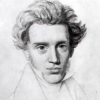
Soren Kierkegaard
Søren Aabye Kierkegaard; 5 May 1813 – 11 November 1855) was a Danish philosopher, theologian, poet, social critic and religious author who is widely considered to be the first existentialist philosopher. He wrote critical texts on organized religion, Christendom, morality, ethics, psychology, and the philosophy of religion, displaying a fondness for metaphor, irony and parables. Much of his philosophical work deals with the issues of how one lives as a "single individual", giving priority to concrete human reality over abstract thinking...
NationalityDanish
ProfessionPhilosopher
Date of Birth5 May 1813
CityCopenhagen, Denmark
CountryDenmark
Soren Kierkegaard quotes about
Theology sits rouged at the window and courts philosophy's favor, offering to sell her charms to it.
On the secretly blushing cheek is reflected the glow of the heart
You should therefore say: alone in one's boat, alone with one's care, alone with one's despair, which one is craven enough to want rather to keep than submit to the pain of being healed.
The proud person always wants to do the right thing, the great thing. But because he wants to do it in his own strength, he is fighting not with man, but with God.
My life is absolutely meaningless. When I consider the different periods into which it falls, it seems like the word Schnur in the dictionary, which means in the first place a string, in the second, a daughter-in-law. The only thing lacking is that the word Schnur should mean in the third place a camel, in the fourth, a dust-brush.
To venture causes anxiety, but not to venture is to lose one's self.... And to venture in the highest is precisely to be conscious of one's self.
It is impossible to exist without passion
The daily press is the evil principle of the modern world, and time will only serve to disclose this fact with greater and greater clearness. The capacity of the newspaper for degeneration is sophistically without limit, since it can always sink lower and lower in its choice of readers. At last it will stir up all those dregs of humanity which no state or government can control.
Human justice is very prolix, and yet at times quite mediocre; divine justice is more concise and needs no information from the prosecution, no legal papers, no interrogation of witnesses, but makes the guilty one his own informer and helps him with eternity's memory.
What if everything in the world were a misunderstanding, what if laughter were really tears?
It is the duty of the human understanding to understand that there are things which it cannot understand...
What is existence for but to be laughed at if men in their twenties have already attained the utmost?
Marriage brings one into fatal connection with custom and tradition, and traditions and customs are like the wind and weather, altogether incalculable.
Because of its tremendous solemnity death is the light in which great passions, both good and bad, become transparent, no longer limited by outward appearences.