Sam Harris
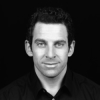
Sam Harris
Samuel Benjamin "Sam" Harrisis an American author, philosopher, and neuroscientist. He is the co-founder and chief executive of Project Reason, a non-profit organization that promotes science and secularism, and host of the podcast Waking Up with Sam Harris. His book The End of Faith, a critique of organized religion, appeared on The New York Times Best Seller list for 33 weeks and also won the PEN/Martha Albrand Award for First Nonfiction in 2005. Letter to a Christian Nationwas a response...
NationalityAmerican
ProfessionStage Actor
Date of Birth4 June 1961
CountryUnited States of America
I was actually already doing my Ph.D. in neuroscience when September 11 happened. 'The End Of Faith' is essentially what September 11 did to my intellectual career at that moment.
[I]t is difficult to imagine a set of beliefs more suggestive of mental illness than those that lie at the heart of many of our religious traditions.
Faith enables many of us to endure life's difficulties with an equanimity that would be scarcely conceivable in a world lit only by reason.
We know enough at this moment to say that the God of Abraham is not only unworthy of the immensity of creation; he is unworthy even of man.
I know of no society in human history that ever suffered because its people became too desirous of evidence in support of their core beliefs.
Although many things can be said in criticism of religious faith, there is no discounting its power. Millions among us, even now, are quite willing to die for our unjustified beliefs, and millions more, it seems, are willing to kill for them.
I think it's just a case in the second half where we stopped penetrating and dishing the ball out. We're an effective team when we do that. We just played the way Union wanted us to - or probably better put, the way they made us.
If we pass the test tonight, we'll continue to evaluate on a daily basis.
While the religious divisions in our world are self-evident, many people still imagine that religious conflict is always caused by a lack of education, by poverty, or by politics.
Most seem to think that while a person may not be responsible for the opportunities he gets in life, each is entirely responsible for what he makes of these opportunities.
We should reserve the notion of 'morality' for the ways in which we can affect one another's experience for better or worse. Some people use the term 'morality' differently, of course, but I think we have a scientific responsibility to focus the conversation so as to make it most useful.
We're right to say that a culture that can't tolerate free speech is... there are a wide range of positive human experiences that are not available in that culture. And we're right to want those experiences.
In my experience with print journalists, the distinction between remarks being uttered on- or off-the-record is held sacrosanct, but the distinction between truth and falsity sometimes isn't.
I don't think there's an interesting boundary between philosophy and science. Science is totally beholden to philosophy. There are philosophical assumptions in science and there's no way to get around that.