Noam Chomsky
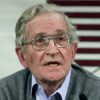
Noam Chomsky
Avram Noam Chomskyis an American linguist, philosopher, cognitive scientist, historian, logician, social critic, and political activist. Sometimes described as "the father of modern linguistics", Chomsky is also a major figure in analytic philosophy, and one of the founders of the field of cognitive science. He has spent more than half a century at the Massachusetts Institute of Technology, where he is Institute Professor Emeritus, and is the author of over 100 books on topics such as linguistics, war, politics, and...
NationalityAmerican
ProfessionTeacher
Date of Birth7 December 1928
CityPhiladelphia, PA
CountryUnited States of America
If you want to scare people, you talk about evil.
There are plenty of things that are unknown, but are assumed reasonably to exist, even in the most basic sciences. Maybe 90 percent of the mass-energy in the universe is called "dark," because nobody knows what it is.
Social and political issues in general seem to me fairly simple; the effort to obfuscate them in esoteric and generally vacuous theory is one of the contributions of the intelligentsia to enhancing their own power and the power of those they serve.
The kind of work that should be the main part of life is the kind of work you would want to do if you weren't being paid for it. It's work that comes out of your own internal needs, interests and concerns.
UG [universal grammar] may be regarded as a characterization of the genetically determined language faculty. One may think of thisfaculty as a 'language acquisition device,' an innate component of the human mind that yields a particular language through interaction with present experience, a device that converts experience into a system of knowledge attained: knowledge of one or another language.
Democracy doesn't mean much if people have to confront concentrated systems of economic power as isolated individuals. Democracy means something if people can organize to gain information, to have thoughts for that matter, to make plans, to enter into the political system in some active way, to put forth programs and so on. If organizations of that kind exist, then democracy can exist too. Otherwise it's a matter of pushing a lever every couple of years; it's like having the choice between Coca-Cola and Pepsi-Cola.
Borders are semiporous. Capital flows more freely than people across them. on C Span.
As any good teacher knows, the methods of instruction and the range of material covered are matters of small importance as compared with the success in arousing the natural curiosity of the students and stimulating their interest in exploring on their own.
The UN can go as far as the U.S. will allow, and no further. And it's bound by conditions that the powerful states, which means mostly the U.S., impose.
All public resources go to the rich. The poor, if they can survive in the labor market, fine. Otherwise, they die. That's economics in a nutshell.
...free enterprise, [is] a term that refers, in practice, to a system of public subsidy and private profit, with massive government intervention in the economy to maintain a welfare state for the rich.
Our yearning for democracy is accompanied by a no less profound yearning for peace. And the media also faced the task of historical engineering to establish this required truth. We therefore have phenomena called 'peace missions' and the 'peace process'. These are terms that apply to whatever the United States happens to be doing or advocating at some moment... in short, 'War is Peace'.
Around 2008 and again in 2013 NATO officially offered the Ukraine the opportunity to join NATO. That's something no Russian government is ever going to accept. It's right at the geopolitical heartland of Russia.
One substitute for the disappearing Evil Empire (The Soviet Union) has been the threat of drug traffickers from Latin America. In early September 1989, a major government-media blitz was launched by the President. That month the AP wires carried more stories about drugs than about Latin America, Asia, the Middle East and Africa combined. If you looked at television, every news program had a big section on how drugs were destroying our society, becoming the greatest threat to our existence, etc.