Joseph Conrad
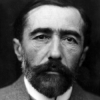
Joseph Conrad
Joseph Conradwas a Polish-British writer regarded as one of the greatest novelists to write in the English language. He joined the British merchant marine in 1878, and was granted British nationality in 1886. Though he did not speak English fluently until he was in his twenties, he was a master prose stylist who brought a non-English sensibility into English literature. He wrote stories and novels, many with a nautical setting, that depict trials of the human spirit in the midst...
NationalityPolish
ProfessionNovelist
Date of Birth3 December 1857
CountryPoland
All creative art is magic, is evocation of the unseen in forms persuasive, enlightening, familiar and surprising.
Do not talk to me of Archimedes' lever. He was an absent-minded person with a mathematical imagination. Mathematics commands my respect, but I have no use for engines. Give me the right word and the right accent and I will move the world.
Truth of a modest sort I can promise you, and also sincerity. That complete, praiseworthy sincerity which, while it delivers one into the hands of one's enemies, is as likely as not to embroil one with one's friends.
You can't breathe dead hippo waking, sleeping, and eating, and at the same time keep your precarious grip on existence.
We couldn't understand because we were too far... and could not remember because we were traveling in the night of first ages, those ages that had gone, leaving hardly a sign... and no memories.
They trespassed upon my thoughts. They were intruders whose knowledge of life was to me an irritating pretense, because I felt so sure they could not possibly know the things I knew. Their bearing, which was simply the bearing of commonplace individuals going about their business in the assurance of perfect safety, was offensive to me like the outrageous flauntings of folly in the face of a danger it is unable to comprehend. I had no particular desire to enlighten them, but I had some difficulty in restraining myself from laughing in their faces, so full of stupid importance.
Conrad placed on the title page an epigraph taken from Edmund Spenser's The Faerie Queene: "Sleep after toyle, port after stormie seas, Ease after warre, death after life, does greatly please" This also became Conrad's epitaph.
He has to live in the midst of the incomprehensible, which is also detestable.
It echoed loudly within him because he was hollow at the core.
She feared the unknown as we all do, and her ignorance made the unknown infinitely vast.
For a time I would feel I belonged still to a world of straightforward facts; but the feeling would not last long. Something would turn up to scare it away.
I suppose everybody must be always just a little homesick.
Everything belonged to him--but that was a trifle. The thing to know was what he belonged to, how many powers of darkness claimed him for their own.
The moon had spread over everything a thin layer of silver - over the rank grass, over the mud, upon the wall of matted vegetation standing higher than the wall of a temple, over the great river I could see through a sombre gap glittering, glittering, as it flowed broadly by without a murmur. All this was great, expectant, mute, while the man jabbered about himself.