Immanuel Kant
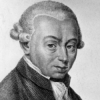
Immanuel Kant
Immanuel Kantwas a German philosopher who is considered the central figure of modern philosophy. Kant argued that fundamental concepts of the human mind structure human experience, that reason is the source of morality, that aesthetics arises from a faculty of disinterested judgment, that space and time are forms of our sensibility, and that the world as it is "in-itself" is unknowable. Kant took himself to have effected a Copernican revolution in philosophy, akin to Copernicus' reversal of the age-old belief...
NationalityGerman
ProfessionPhilosopher
Date of Birth22 April 1724
CountryGermany
The light dove, cleaving the air in her free flight, and feeling its resistance, might imagine that its flight would be still easier in empty space.
A science of all these possible kinds of space [the higher dimensional ones] would undoubtedly be the highest enterprise which a finite understanding could undertake in the field of geometry... If it is possible that there could be regions with other dimensions, it is very likely that God has somewhere brought them into being.
We come no nearer the infinitude of the creative power of God, if we enclose the space of its revelation within a sphere described with the radius of the Milky Way, than if we were to limit it to a ball an inch in diameter. All that is finite, whatever has limits and a definite relation to unity, is equally far removed from the infinite... Eternity is not sufficient to embrace the manifestations of the Supreme Being, if it is not combined with the infinitude of space.
Here I shall add that the concept of change, and with it the concept of motion, as change of place, is possible only through and in the representation of time. & Motion, for example, presupposes the perception of something movable. But space considered in itself contains nothing movable; consequently motion must be something which is found in space only through experience -in other words, is an empirical datum.
Natural science physics contains in itself synthetical judgments a priori, as principles. ... Space then is a necessary representation a priori, which serves for the foundation of all external intuitions.
Space and time are the framework within which the mind is constrained to construct its experience of reality.
To be fully comfortable to the principle of right, the form of government must be representative. This is the only one that permits republicanism, without which the government is arbitrary and despotic, whatever the constitution may be.
The possession of power unavoidably spoils the free use of reason
So act that your principle of action might safely be made a law for the whole world.
Reason does not work instinctively, but requires trial, practice, and instruction in order to gradually progress from one level of insight to another
I learned to honor human beings, and I would find myself far more useless than the common laborer if I did not believe that this consideration could impart to all others a value establishing the rights of humanity.
I feel a complete thirst for knowledge and an eager unrest to go further in it as well as satisfaction at every acquisition. There was a time when I believed that this alone could constitute the honor of mankind, and I had contempt for the ignorant rabble who know nothing.
I am myself by inclination an investigator.
We can never, even by the strictest examination, get completely behind the secret springs of action.