Immanuel Kant
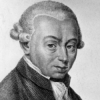
Immanuel Kant
Immanuel Kantwas a German philosopher who is considered the central figure of modern philosophy. Kant argued that fundamental concepts of the human mind structure human experience, that reason is the source of morality, that aesthetics arises from a faculty of disinterested judgment, that space and time are forms of our sensibility, and that the world as it is "in-itself" is unknowable. Kant took himself to have effected a Copernican revolution in philosophy, akin to Copernicus' reversal of the age-old belief...
NationalityGerman
ProfessionPhilosopher
Date of Birth22 April 1724
CountryGermany
Animals... are there merely as a means to an end. That end is man.
Nature has willed that man should, by himself, produce everything that goes beyond the mechanical ordering of his animal existence, and that he should partake of no other happiness or perfection than that which he himself, independently of instinct, has created by his own reason.
cruelty to animals is contrary to man's duty to himself, because it deadens in him the feeling of sympathy for their sufferings, and thus a natural tendency that is very useful to morality in relation to other human beings is weakened.
He who is cruel to animals becomes hard also in his dealings with men. We can judge the heart of a man by his treatment of animals.
The more we come in contact with animals and observe their behaviour, the more we love them, for we see how great is their care of the young.
We can judge the heart of a man by his treatment of animals.
To be fully comfortable to the principle of right, the form of government must be representative. This is the only one that permits republicanism, without which the government is arbitrary and despotic, whatever the constitution may be.
The possession of power unavoidably spoils the free use of reason
So act that your principle of action might safely be made a law for the whole world.
Reason does not work instinctively, but requires trial, practice, and instruction in order to gradually progress from one level of insight to another
I learned to honor human beings, and I would find myself far more useless than the common laborer if I did not believe that this consideration could impart to all others a value establishing the rights of humanity.
I feel a complete thirst for knowledge and an eager unrest to go further in it as well as satisfaction at every acquisition. There was a time when I believed that this alone could constitute the honor of mankind, and I had contempt for the ignorant rabble who know nothing.
I am myself by inclination an investigator.
We can never, even by the strictest examination, get completely behind the secret springs of action.