Friedrich Nietzsche
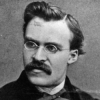
Friedrich Nietzsche
Friedrich Wilhelm Nietzschewas a German philosopher, cultural critic, poet and Latin and Greek scholar whose work has exerted a profound influence on Western philosophy and modern intellectual history. He began his career as a classical philologist before turning to philosophy. He became the youngest ever to hold the Chair of Classical Philology at the University of Basel in 1869, at the age of 24. Nietzsche resigned in 1879 due to health problems that plagued him most of his life, and...
NationalityGerman
ProfessionPhilosopher
Date of Birth15 October 1844
CityRocken, Germany
CountryGermany
One must never have spared oneself, one must have acquired hardness as a habit to be cheerful and in good spirits in the midst of nothing but hard truths.
That roguish and cheerful vice, politeness.
It is certainly not the least charm of a theory that it is refutable.
It is regrettable that a Dostoyevsky did not live near this most interesting of all decadents (Jesus Christ) - I mean someone who would have known how to sense the very stirring charm of such a mixture of the sublime, the sickly, and the childlike.
There was at all events one advantage in the choice of this day to my birth; my birthday throughout the whole of my childhood was a day of public rejoicing.
Whoever is related to me in the height of his aspirations will experience veritable ecstasies of learning; for I come from heights that no bird ever reached in its flight, I know abysses into which no foot ever strayed.
History is nothing more than the belief in the senses, the belief in falsehood.
How did reason come into the world? As is fitting, in an irrational manner, by accident. One will have to guess at it as at a riddle.
With the unknown, one is confronted with danger, discomfort, and care; the first instinct is to abolish these painful states. First principle: any explanation is better than none. . . . The causal instinct is thus conditional upon, and excited by, the feeling of fear. The "why?" shall, if at all possible, not give the cause for its own sake so much as for a particular kind of cause -- a cause that is comforting, liberating, and relieving.
Emerson is a person who lives instinctively on ambrosia - and leaves everything indigestible on his plate.
In this moment, I am euphoric. Not because of any phony god's blessing. But because, I am enlightened by my intelligence.
The hour-hand of life.
Perhaps man will rise ever higher as soon as he ceases to flow out into a god.
I listened for the echo, and I heard only praise —