Friedrich Nietzsche
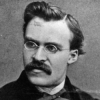
Friedrich Nietzsche
Friedrich Wilhelm Nietzschewas a German philosopher, cultural critic, poet and Latin and Greek scholar whose work has exerted a profound influence on Western philosophy and modern intellectual history. He began his career as a classical philologist before turning to philosophy. He became the youngest ever to hold the Chair of Classical Philology at the University of Basel in 1869, at the age of 24. Nietzsche resigned in 1879 due to health problems that plagued him most of his life, and...
NationalityGerman
ProfessionPhilosopher
Date of Birth15 October 1844
CityRocken, Germany
CountryGermany
Those who are failures from the start, downtrodden, crushed -- it is they, the weakest, who must undermine life among men, who call into question and poison most dangerously our trust in life, in man, and in ourselves.
Physician, help yourself: thus help your patient too. Let this be his best help: that he may behold with his eyes the man who heals himself.
I do not give alms; I am not poor enough for that.
In constructing concepts, we overlook the fact that no two things are the same. There is no such thing as the concept of a leaf, only billions and billions of leaves.
Morality in Europe today is herd-morality
What I understand by "philosopher": a terrible explosive in the presence of which everything is in danger.
The so called unconscious inferences can be traced back to the all-preserving memory, which presents us with parallel experiences and hence already knows the consequences of an action. It is not anticipation of the effects; rather, it is the feeling: identical causes, identical effects . . .
The bite of conscience, like the bite of a dog into a stone, is a stupidity.
Little prigs and three-quarter madmen may have the conceit that the laws of nature are constantly broken for their sakes.
One begins to mistrust very clever people when they become embarrassed.
The surest aid in combating the male's disease of self-contempt is to be loved by a clever woman.
A high civilization is a pyramid: it can stand only on a broad base; its primary prerequisite is a strong and soundly consolidated mediocrity.
When one gives up the Christian faith, one pulls the right to Christian morality out from under one's feet. This morality is by no means self-evident. Christianity is a system, a whole view of things thought out together. By breaking one main concept out of it, the faith in God, one breaks the whole. It stands or falls with faith in God.
Assuming that he believes at all, the everyday Christian is a pitiful figure, a man who really cannot count up to three, and who besides, precisely because of his mental incompetence, would not deserve such a punishment as Christianity promises him.