Friedrich Nietzsche
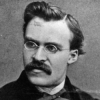
Friedrich Nietzsche
Friedrich Wilhelm Nietzschewas a German philosopher, cultural critic, poet and Latin and Greek scholar whose work has exerted a profound influence on Western philosophy and modern intellectual history. He began his career as a classical philologist before turning to philosophy. He became the youngest ever to hold the Chair of Classical Philology at the University of Basel in 1869, at the age of 24. Nietzsche resigned in 1879 due to health problems that plagued him most of his life, and...
NationalityGerman
ProfessionPhilosopher
Date of Birth15 October 1844
CityRocken, Germany
CountryGermany
One had better put on gloves before handling the New Testament. The presence of so much filth makes it highly advisable.
One does not kill by anger but by laughter.
Sins are indispensable to every society organized on an ecclesiastical basis; they are the only reliable weapons of power; the priest lives upon sins; it is necessary to him that there be sinning.
Whenever the truth is uncovered, the artist will always cling with rapt gaze to what still remains covering even after such uncovering; but the theoretical man enjoys and finds satisfaction in the discarded covering and finds the highest object of his pleasure in the process of an ever happy uncovering that succeeds through his own efforts.
The Hour-Hand of Life --- Life consists of rare, isolated moments of the greatest significance, and of innumerably many intervals, during which at best the silhouettes of those moments hover about us. Love, springtime, every beautiful melody, mountains, the moon, the sea - all these speak completely to the heart but once, if in fact they ever do get a chance to speak completely. For many men do not have those moments at all, and are themselves intervals and intermissions in the symphony of real life.
I have been casting shadows all my life without caring about how deeply they stain my soul.
It is not your sin - it is your moderation that cries to heaven; your very sparingness in sin cries to heaven!
It is only great pain--that slow, sustained pain that takes its time, in which we are, as it were, burned with smoldering green firewood--that forces us philosophers to sink to our ultimate profundity and to do away with all the trust, everything good-natured, veil-imposing, mild and middling, on which we may have previously based our humanity. I doubt that such a pain makes us 'better'--but I know that it makes us deeper.
I am the leading strings of the ego and the prompter of its concepts.
When death brings at last the desired forgetfulness, it abolishes life and being together, and sets the seal on the knowledge that "being" is merely a continual "has been," a thing that lives by denying and destroying and contradicting itself.
To live as I incline, or not to live at all: so do I wish; so wisheth also the holiest. But alas! how have I still - inclination? Have I-still a goal? A haven towards which MY sail is set?A good wind? Ah, he only who knoweth WHITHER he saileth, knoweth what wind is good, and a fair wind for him.What still remaineth to me? A heart weary and flippant; and unstable will; fluttering wings; a broken backbone.This seeking for MY home: O Zarathustra, dost thou know that this seeking hath been MY home-sickening; it eateth me up.
The reason adultery is immoral is that it might lead to marriage.
Such men alone are my readers, my proper readers, my preordained readers. Of what account are the rest? The rest are simply... humanity. One must be superior to humanity in power, in loftiness of soul- in contempt.
Though the favourites of the Gods die young, they also live eternally in the company of Gods