Friedrich Nietzsche
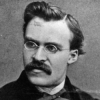
Friedrich Nietzsche
Friedrich Wilhelm Nietzschewas a German philosopher, cultural critic, poet and Latin and Greek scholar whose work has exerted a profound influence on Western philosophy and modern intellectual history. He began his career as a classical philologist before turning to philosophy. He became the youngest ever to hold the Chair of Classical Philology at the University of Basel in 1869, at the age of 24. Nietzsche resigned in 1879 due to health problems that plagued him most of his life, and...
NationalityGerman
ProfessionPhilosopher
Date of Birth15 October 1844
CityRocken, Germany
CountryGermany
The ordinary man is as courageous and invulnerable as a hero when he does not recognize any danger, when he has no eyes to see it.Conversely, the hero's only vulnerable spot is on his back, and so exactly where he has no eyes.
This is one of the stout-hearted old warriors: he is angry with civilization because he supposes that its aim is to make all goodthings--honors, treasures, beautiful women--accessible even to cowards.
Desire is happiness: satisfaction as happiness is merely the ultimate moment of desire. To be wish and wish alone is happiness, and a new wish over and over again.
Women want to serve, and this is where their happiness lies: but the free spirit does not want to be served, and this is where hishappiness lies.
Man is at his furthest remove from the animal as a child, his intellect most human. With his fifteenth year and puberty he comes astep closer to the animal; with the sense of possessions of his thirties (the median line between laziness and greediness), still another step. In his sixtieth year of life he frequently loses his modesty as well, then the septuagenarian steps up to us as a completely unmasked beast: one need only look at the eyes and the teeth.
Once and for all, there are many things I choose not to know.--Wisdom sets limits even to knowledge.
To become wise you have to want to experience certain experiences, and so to run into their open jaws. This is very dangerous, tobe sure; many a "wise man" has been eaten up in doing so.
It was modesty that invented the word "philosopher" in Greece and left the magnificent overweening presumption in calling oneselfwise to the actors of the spirit--the modesty of such monsters of pride and sovereignty as Pythagoras, as Plato.
Scholarship has the same relationship to wisdom as righteousness has to holiness: it is cold and dry, it is loveless and knows nodeep feelings of inadequacy or longing.
The flame is not as bright to itself as it is to those it illuminates: so too the sage.
The thought is merely a sign, as the word is merely a sign for the thought.
We cannot even reproduce our thoughts entirely in words.
Those with very loud voices in their throats are nearly incapable of thinking subtle thoughts.
To one who is accustomed to thinking a lot, every new thought that he hears or reads about immediately appears as a link in a chain.