Evo Morales
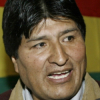
Evo Morales
Juan Evo Morales Ayma, popularly known as Evo, is a Bolivian politician and cocalero activist who has served as President of Bolivia since 2006. Widely regarded as the country's first president to come from the indigenous population, his administration has focused on the implementation of leftist policies, poverty reduction, and combating the influence of the United States and multinational corporations in Bolivia. A democratic socialist, he is the head of the Movement for Socialismparty...
NationalityBolivian
ProfessionPolitician
Date of Birth26 October 1959
CityOrinoca, Bolivia
CountryBolivia (Plurinational State of)
With our goddess, the Pachamama, and it is not possible to continue having a monopoly of religious faith, only Catholic. We have therefore adopted the new constitution as a secular state where all religious beliefs will be respected.
I'm much more convinced that the hierarchy comes from the monarchy, and that the hierarchy stays apart from the oligarchy. So the oligarchy is hurtful to the majority in Bolivia.
I am Catholic but I want to say something to the Catholics. Thank you for some of the bishops who live in rural areas, and are still Catholic. These bishops of the Catholic churches still pray for the poor, and pray for their president who works for the poor, while the leaders of the Catholic Church only defend oligarchy.
I haven't come here to ask for anything, just for advice and orientation. He (Silva) is a great companion of mine. As a Latin American, he is my brother.
It's not about conquering, it's about convincing, persuading about our concrete proposals with transparency and honesty.
In 2005, before I was president, the state of Bolivia had only $300 million from hydrocarbons. Last year, 2007, the Bolivian state - after the nationalization, after changing the law - Bolivia received $1,930 million. For a small country with nearly 10 million inhabitants, this allows us to increase the national economy.
That's how life is in peasant families. What luck that three of us survived!
Its a question of sharing the country's situation among us all.
The work groups will draw up commercial and cooperation agreements.
There will not be zero coca, but there will be zero cocaine.
Everyone knows that the court is a product of the old parties. If I were a member of that court, I would resign.
As with any country, we have the right to manage our own resources. This doesn't mean expelling foreign companies or expropriating foreign property. Foreign companies have every right to recover investments and make profits, but profits should be balanced.
This is a democratic revolution and we will answer the Bolivian people's call.
They're won't be zero coca, but there will by zero drug trafficking.