Evo Morales
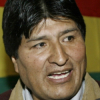
Evo Morales
Juan Evo Morales Ayma, popularly known as Evo, is a Bolivian politician and cocalero activist who has served as President of Bolivia since 2006. Widely regarded as the country's first president to come from the indigenous population, his administration has focused on the implementation of leftist policies, poverty reduction, and combating the influence of the United States and multinational corporations in Bolivia. A democratic socialist, he is the head of the Movement for Socialismparty...
NationalityBolivian
ProfessionPolitician
Date of Birth26 October 1959
CityOrinoca, Bolivia
CountryBolivia (Plurinational State of)
In 2006, I entered the presidential palace in the main square of La Paz as the first indigenous president of Bolivia. Our government, under the slogan 'Bolivia Changes,' is committed to ending the colonialism, racism and exclusion that many of our people lived under for many centuries.
I don't mind being a permanent nightmare for the United States.
It's easy for people in an air-conditioned room to continue with the policies of destruction of Mother Earth. We need instead to put ourselves in the shoes of families in Bolivia and worldwide that lack water and food and suffer misery and hunger.
The most important thing is the indigenous people are not vindictive by nature. We are not here to oppress anybody - but to join together and build Bolivia, with justice and equality.
The contracts were signed when a barrel of oil cost 18.0 or 19.0 dollars, whereas nowadays a barrel is more than 60.0 dollars.
We are not a government of mere promises, we follow through on what we propose and what the people demand.
Some take advantage of natural resources to put the capital in the hands of the few, while some use these natural resources to benefit the majority, as we do in Bolivia.
State control is important for the people who have always been excluded from the claims of social and economic development.
I never wore a tie voluntarily, even though I was forced to wear one for photos when I was young and for official events at school. I used to wrap my tie in a newspaper, and whenever the teacher checked I would quickly put it on again. I'm not used to it. Most Bolivians don't wear ties.
In Bolivia there are Catholic, Evangelical, Methodist, Baptist churches, and so on. In Bolivia there are indigenous religious beliefs like the rite of Pachamama Mother Earth, which shows us that Mother Earth is our life, we are born out of the Earth we live on the Earth and return to the Earth.
Now we are immersed in deep democratic revolutions, for the recovery of our resources, and to transform a resource into a basic human right. And that is spread around the world.
The United States is using its war on drugs as an excuse to expand its control over Latin America.
We nationalize hydrocarbons, so now the economy is improving and the fight against poverty is also improving in Bolivia.
From my standpoint, coca should be neither destroyed nor completely legalized. Farming should be controlled by the state and by the coca farmers' unions.