David Hume
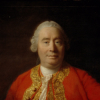
David Hume
David Hume– 25 August 1776) or David Homewas a Scottish philosopher, historian, economist, and essayist, who is best known today for his highly influential system of radical philosophical empiricism, skepticism, and naturalism...
NationalityScottish
ProfessionPhilosopher
Date of Birth7 May 1711
lying science reality
In all matters of opinion and science ... the difference between men is ... oftener found to lie in generals than in particulars; and to be less in reality than in appearance. An explication of the terms commonly ends the controversy, and the disputants are surprised to find that they had been quarrelling, while at bottom they agreed in their judgement.
art honesty science
'Tis certain that a serious attention to the sciences and liberal arts softens and humanizes the temper, and cherishes those fine emotions in which true virtue and honor consist. It rarely, very rarely happens that a man of taste and learning is not, at least, an honest man, whatever frailties may attend him.
science past imagination
We have no other notion of cause and effect, but that of certain objects, which have always conjoin'd together, and which in all past instances have been found inseparable. We cannot penetrate into the reason of the conjunction. We only observe the thing itself, and always find that from the constant conjunction the objects acquire an union in the imagination.
beautiful science fabric
There is nothing, in itself, valuable or despicable, desirable or hateful, beautiful or deformed; but that these attributes arise from the particular constitution and fabric of human sentiment and affection.
philosophy philosophical science
Generally speaking, the errors in religion are dangerous; those in philosophy only ridiculous.
life science men
The life of man is of no greater importance to the universe than that of an oyster.
philosophy philosophical science
Be a philosopher but, amid all your philosophy be still a man.
avenues either esteemed leads life mankind open path remove science sweetest whoever
The sweetest and most inoffensive path of life leads through the avenues of science and learning; and whoever can either remove any obstruction in this way, or open up any new prospect, ought, so far, to be esteemed a benefactor to mankind
affairs appears consider ease few governed human surprising
Nothing appears more surprising to those who consider human affairs with a philosophical eye, than the ease with which the many are governed by the few
excellent happy suit temper whose
He is happy whose circumstances suit his temper but he is more excellent who can suit his temper to any circumstances.
character government law
How could politics be a science, if laws and forms of government had not a uniform influence upon society? Where would be the foundation of morals, if particular characters had no certain or determinate power to produce particular sentiments, and if these sentiments had no constant operation on actions?
beauty reflection mind
If the contemplation, even of inanimate beauty, is so delightful; if it ravishes the senses, even when the fair form is foreign tous: What must be the effects of moral beauty? And what influence must it have, when it embellishes our own mind, and is the result of our own reflection and industry?
doubt religion mystery
The whole [of religion] is a riddle, an ænigma, an inexplicable mystery. Doubt, uncertainty, suspence of judgment appear the onlyresult of our most accurate scrutiny, concerning this subject.
spring intelligent secret
Every disastrous accident alarms us, and sets us on enquiries concerning the principles whence it arose: Apprehensions spring up with regard to futurity: And the mind, sunk into diffidence, terror, and melancholy, has recourse to every method of appeasing those secret intelligent powers, on whom our fortune is supposed entirely to depend.