Blaise Pascal
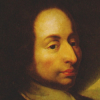
Blaise Pascal
Blaise Pascalwas a French mathematician, physicist, inventor, writer and Christian philosopher. He was a child prodigy who was educated by his father, a tax collector in Rouen. Pascal's earliest work was in the natural and applied sciences where he made important contributions to the study of fluids, and clarified the concepts of pressure and vacuum by generalising the work of Evangelista Torricelli. Pascal also wrote in defence of the scientific method...
NationalityFrench
ProfessionPhilosopher
Date of Birth19 June 1623
CityClermont-Ferrand, France
CountryFrance
Who dispenses reputation? Who makes us respect and revere persons, works, laws, the great? Who but this faculty of imagination? All the riches of the earth are inadequate without its approval.
Thinking too little about things or thinking too much both make us obstinate and fanatical.
The imagination enlarges little objects so as to fill our souls with a fantastic estimate; and, with rash insolence, it belittles the great to its own measure, as when talking of God.
That which makes us go so far for love is that we never think that we might have need of anything besides that which we love.
Silence is the greatest persecution; never do the saints keep themselves silent.
Put the world's greatest philosopher on a plank that is wider than need be; if there is a precipe below, although his reason may convince him that he is safe, his imagination will prevail.
Man is so made that if he is told often enough that he is a fool he believes it.
Man is so made that by continually telling him he is a fool he believes it, and by continually telling it to himself he makes himself believe it. For man holds an inward talk with himself, which it pays him to regulate.
The truth about nature we discover with our brains. The truth about religion we discover with our hearts.
The entire ocean is affected by a single pebble.
The Fall is an offense to human reason, but once accepted, it makes perfect sense of the human condition.
Let man then contemplate nature in full and lofty majesty, and turn his eyes away from the mean objects which surround him. Let him look at the dazzling light hung aloft as an eternal lamp to lighten the universe; let him behold the earth, a mere dot compared with the vast circuit which that orb describes, and stand amazed to find that the vast circuit itself is but a very fine point compared with the orbit traced by the starts as they roll their course on high.
There are two excesses: to exclude reason, to admit nothing but reason. The supreme achievement of reason is to realise that there is a limit to reason. Reason's last step is the recognition that there are an infinite number of things which are beyond it. It is merely feeble if it does not go as far as to realise that.
At the centre of every human being is a God-shaped vacuum which can only be filled by Jesus Christ.