Blaise Pascal
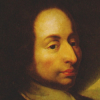
Blaise Pascal
Blaise Pascalwas a French mathematician, physicist, inventor, writer and Christian philosopher. He was a child prodigy who was educated by his father, a tax collector in Rouen. Pascal's earliest work was in the natural and applied sciences where he made important contributions to the study of fluids, and clarified the concepts of pressure and vacuum by generalising the work of Evangelista Torricelli. Pascal also wrote in defence of the scientific method...
NationalityFrench
ProfessionPhilosopher
Date of Birth19 June 1623
CityClermont-Ferrand, France
CountryFrance
(Man,) the glory and the scandal of the universe.
I should not be a Christian but for the miracles.
All the trouble in the world is due to the fact that man cannot sit still in a room.
The Stoics say, "Retire within yourselves; it is there you will find your rest." And that is not true. Others say, "Go out of yourselves; seek happiness in amusement." And this is not true. Illness comes. Happiness is neither without us nor within us. It is in God, both without us and within us.
When we wish to correct with advantage, and to show another that he errs, we must notice from what side he views the matter, for on that side it is usually true.
When some passion or effect is described in a natural style, we find within ourselves the truth of what we hear, without knowing it was there.
Jurisdiction is not given for the sake of the judge, but for that of the litigant.
Excuse me, pray." Without that excuse I would not have known there was anything amiss.
Vanity is so secure in the heart of man that everyone wants to be admired: even I who write this, and you who read this.
When a man who accepts the Christian doctrine lives unworthily of it, it is much clearer to say he is a bad Christian than to say he is not a Christian.
I condemn equally those who choose to praise man, those who choose to condemn him and those who choose to divert themselves, and I can only approve of those who seek with groans.
I cannot judge my work while I am doing it. I have to do as painters do, stand back and view it from a distance, but not too great a distance. How great? Guess.
Without the knowledge of our wretchedness, the knowledge of God creates pride. With it, the knowledge of God creates despair. The knowledge of Christ offers a third way, because in him we find both God and our wretchedness.
Our notion of symmetry is derived form the human face. Hence, we demand symmetry horizontally and in breadth only, not vertically nor in depth.