Bertrand Russell
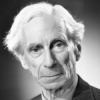
Bertrand Russell
Bertrand Arthur William Russell, 3rd Earl Russell, OM, FRSwas a British philosopher, logician, mathematician, historian, writer, social critic, political activist and Nobel laureate. At various points in his life he considered himself a liberal, a socialist, and a pacifist, but he also admitted that he had "never been any of these things, in any profound sense". He was born in Monmouthshire into one of the most prominent aristocratic families in the United Kingdom...
NationalityBritish
ProfessionPhilosopher
Date of Birth18 May 1872
Worry is a form of fear.
It is a curious and painful fact that almost all the completely futile treatments that have been believed in during the long history of medical folly have been such as caused acute suffering to the patient. When anesthetics were discovered, pious people considered them an attempt to evade the will of God. It was pointed out, however, that when God extracted Adam's rib He put him into a deep sleep. This proved that anesthetics are all right for men; women, however, ought to suffer, because of the curse of Eve.
One of the chief obstacles to intelligence is credulity, and credulity could be enormously diminished by instructions as to the prevalent forms of mendacity. Credulity is a greater evil in the present day than it ever was before, because, owing to the growth of education, it is much easier than it used to be to spread misinformation, and, owing to democracy, the spread of misinformation is more important than in former times to the holders of power.
What's the difference between a bright, inquisitive five-year-old, and a dull, stupid nineteen-year-old? Fourteen years of the British educational system.
Continuity of purpose is one of the most essential ingredients of happiness in the long run, and for most men that comes chiefly through their work.
Science, in its ultimate ideal, consists of a set of propositions arranged in a hierarchy, the lowest level of the hierarchy being concerned with particular facts, and the highest with some general law, governing everything in the universe. The various levels in the hierarchy have a two-fold logical connection, travelling one up, one down; the upward connection proceeds by induction, the downward by deduction.
The significance of a fact is relative to [the general body of scientific] knowledge. To say that a fact is significant in science, is to say that it helps to establish or refute some general law; for science, though it starts from observation of the particular, is not concerned essentially with the particular, but with the general. A fact, in science, is not a mere fact, but an instance. In this the scientist differs from the artist, who, if he deigns to notice facts at all, is likely to notice them in all their particularity.
The first man who said "fire burns" was employing scientific method, at any rate if he had allowed himself to be burnt several times. This man had already passed through the two stages of observation and generalization. He had not, however, what scientific technique demands-a careful choice of significant facts on the one hand, and, on the other hand, various means of arriving at laws otherwise than my mere generalization.
Scientific method, although in its more refined forms it may seem complicated, is in essence remarkably simply. It consists in observing such facts as will enable the observer to discover general laws governing facts of the kind in question. The two stages, first of observation, and second of inference to a law, are both essential, and each is susceptible of almost indefinite refinement. (1931)
Cruelty is, in theory, a perfectly adequate ground for divorce, but it may be interpreted so as to become absurd.
Ideas and principles that do harm are as a rule, though not always, cloaks for evil passions.
There's a Bible on that shelf there. But I keep it next to Voltaire - poison and antidote.
Much of the most important evils that mankind have to consider are those which they inflict upon each other through stupidity or malevolence or both.
Real life is, to most men, a long second best, a perpetual compromise between the ideal and the possible.