Thomas Jefferson
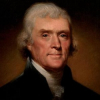
Thomas Jefferson
Thomas Jeffersonwas an American Founding Father who was the principal author of the Declaration of Independence. He was elected the second Vice President of the United States, serving under John Adams and in 1800 was elected the third President. Jefferson was a proponent of democracy, republicanism, and individual rights, which motivated American colonists to break from Great Britain and form a new nation. He produced formative documents and decisions at both the state and national level...
NationalityAmerican
ProfessionUS President
Date of Birth13 April 1743
CityShadwell, VA
CountryUnited States of America
You have heard of the new chemical nomenclature endeavored to be introduced by Lavoisier, Fourcroy, &c. Other chemists of this country, of equal note, reject it, and prove in my opinion that it is premature, insufficient and false. These latter are joined by the British chemists; and upon the whole, I think the new nomenclature will be rejected, after doing more harm than good. There are some good publications in it, which must be translated into the ordinary chemical language before they will be useful.
The contradictory experiments of chemists leave us at liberty to conclude what we please. My conclusion is, that art has not yet invented sufficient aids to enable such subtle bodies [air, light, &c.] to make a well-defined impression on organs as blunt as ours; that it is laudable to encourage investigation but to hold back conclusion.
The attempt of Lavoisier to reform chemical nomenclature is premature. One single experiment may destroy the whole filiation of his terms; and his string of sulphates, sulphites, and sulphures, may have served no end than to have retarded the progress of science by a jargon, from the confusion of which time will be requisite to extricate us.
Speaking one day to Monsieur de Buffon, on the present ardor of chemical inquiry, he affected to consider chemistry but as cookery, and to place the toils of the laboratory on the footing with those of the kitchen. I think it, on the contrary, among the most useful of sciences, and big with future discoveries for the utility and safety of the human race.
I have wished to see chemistry applied to domestic objects, to malting, for instance, brewing, making cider, to fermentation and distillation generally, to the making of bread, butter, cheese, soap, to the incubation of eggs, &c.
I do not know whether you are fond of chemical reading. There are some things in this science worth reading.
Chemistry is yet, indeed, a mere embryon. Its principles are contested; experiments seem contradictory; their subjects are so minute as to escape our senses; and their result too fallacious to satisfy the mind. It is probably an age too soon to propose the establishment of a system.
The future inhabitants of [both] the Atlantic and Mississippi states will be our sons. We think we see their happiness in their union, and we wish it. Events may prove otherwise; and if they see their interest in separating why should we take sides? God bless them both, and keep them in union if it be for their good, but separate them if it be better.
The order of nature [is] that individual happiness shall be inseparable from the practice of virtue.
When habit has strengthened our sense of duties, they leave us no time for other things; but when young we neglect them and this gives us time for anything.
Yet the hour of emancipation is advancing ... this enterprise is for the young; for those who can follow it up, and bear it through to it's consummation. It shall have all my prayers, and these are the only weapons of an old man.
An individual, thinking himself injured, makes more noise than a State.
The mobs of the great cities add just so much to the support of pure government as sores do to the strength of the human body. It is the manners and spirit of a people which preserve a republic in vigor. A degeneracy in these is a canker which soon eats to the heart of its laws and constitution.
Liberty is to the collective body, what health is to every individual body. Without health no pleasure can be tasted by man; without liberty, no happiness can be enjoyed by society.