T. S. Eliot
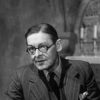
T. S. Eliot
Thomas Stearns Eliot OMwas an American-born British essayist, publisher, playwright, literary and social critic and "one of the twentieth century's major poets". He moved to England in 1914 at age 25, settling, working and marrying there. He was eventually naturalised as a British subject in 1927 at age 39, renouncing his American citizenship...
NationalityAmerican
ProfessionPoet
Date of Birth26 September 1888
CountryUnited States of America
time winter journey
A cold coming we had of it, Just the worst time of the year For a journey, and such a long journey: The ways deep and the weather sharp, The very dead of winter.
men soul creation
The soul of Man must quicken to creation.
patience dying littles
He who was living is now dead We who were living are now dying With a little patience.
knowledge men littles
We can say of Shakespeare, that never has a man turned so little knowledge to such great account.
appreciation art generations
No generation is interested in art in quite the same way as any other; each generation, like each individual, brings to the contemplation of art its own categories of appreciation, makes its own demands upon art, and has its own uses for art.
eye firsts deceit
It is generally a feminine eye that first detects the moral deficiencies hidden under the 'dear deceit' of beauty.
fighting expectations alive
We fight to keep something alive rather than in the expectation that anything will triumph.
dog play towns
The usual dog about the town is much inclined to play the clown.
health insanity despair
Where does one go from a world of insanity? Somewhere on the other side of despair.
appreciation art poet
No poet, no artist of any art, has his complete meaning alone. His significance, his appreciation is the appreciation of his relation to the dead poets and artists. You cannot value him alone; you must set him, for contrast and comparison, among the dead.
order civilization language
Poets in our civilization, as it exists at present, must be difficult...The poet must become more and more comprehensive, more allusive, more indirect, in order to force, to dislocate if necessary, language into its meaning.
believe thinking world
I must tell you that I should really like to think there's something wrong with me- Because, if there isn't, then there's something wrong with the world itself-and that's much more frightening! That would be terrible. So I'd rather believe there is something wrong with me, that could be put right.
lying adequacy emotion
Artistic inevitability lies in the complete adequacy of the external to the emotion.
moving believe our-actions
All time is eternal, moving inexorably toward an end which we believe is a result of our actions, but over which our control is mere illusion.