Samuel Johnson
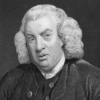
Samuel Johnson
Samuel Johnson, often referred to as Dr Johnson, was an English writer who made lasting contributions to English literature as a poet, essayist, moralist, literary critic, biographer, editor and lexicographer. Johnson was a devout Anglican and committed Tory, and has been described as "arguably the most distinguished man of letters in English history". He is also the subject of "the most famous single biographical work in the whole of literature," James Boswell's Life of Samuel Johnson...
NationalityEnglish
ProfessionNon-Fiction Author
Date of Birth18 September 1709
I have ever since (his wife's death) seemed to myself broken off from mankind; a kind of solitary wanderer in the wild of life, without any direction, or fixed point of view: a gloomy gazer on the world to which I have little relation
Sir, we are a nest of singing birds
There are minds which easily sink into submission, that look on grandeur with undistinguishing reverence, and discover no defect where there is elevation of rank and affluence of riches
Surely life, if it be not long, is tedious, since we are forced to call in the assistance of so many trifles to rid us of our time, of that time which never can return.
Those who attain to any excellence commonly spend life in some single pursuit, for excellence is not often gained upon easier terms.
No man forgets his original trade: the rights of nations and of kings sink into questions of grammar, if grammarians discuss them
We ought not to raise expectations which it is not in our power to satisfy.-It is more pleasing to see smoke brightening into flame, than flame sinking into smoke.
A vow is a snare for sin
Nay, Madam, when you are declaiming, declaim; and when you are calculating, calculate.
There lurks, perhaps, in every human heart a desire of distinction, which inclines every man first to hope, and then to believe, that Nature has given him something peculiar to himself.
What signifies protesting so against flattery! when a person speaks well of one, it must either be true or false, you know; if true, let us rejoice in his good opinion; if he lies, it is a proof at least that he loves more to please me, than to sit s
To act from pure benevolence is not possible for finite human beings, Human benevolence is mingled with vanity, interest, or some other motive.
With regard to the sharpest and most melting sorrow, that which arises from the loss of those whom we have loved with tenderness, it may be observed, that friendship between mortals can be contracted on no other terms than that one must some time mou
Every quotation contributes something to the stability or enlargement of the language.