Samuel Johnson
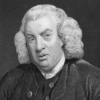
Samuel Johnson
Samuel Johnson, often referred to as Dr Johnson, was an English writer who made lasting contributions to English literature as a poet, essayist, moralist, literary critic, biographer, editor and lexicographer. Johnson was a devout Anglican and committed Tory, and has been described as "arguably the most distinguished man of letters in English history". He is also the subject of "the most famous single biographical work in the whole of literature," James Boswell's Life of Samuel Johnson...
NationalityEnglish
ProfessionNon-Fiction Author
Date of Birth18 September 1709
My Dear Sir: Are you playing the same trick again, and trying who can keep silence longest? Remember that all tricks are either knavish or childish; and that it is as foolish to make experiments upon the constancy of a friend as upon the chastity o
Let him who desires to see others happy, make haste to give while his gift can be enjoyed, and remember that every moment of delay takes away something from the value of his benefaction
Of the innumerable authors whose performances are thus treasured up in magnificent obscurity (in a library), most are forgotten, because they never deserved to be remembered
The happiest conversation is that of which nothing is distinctly remembered but a general effect of pleasing impression.
What is read twice is usually remembered more than what is once written.
Every reader should remember the diffidence of Socrates, and repair by his candour the injuries of time: he should impute the seeming defects of his author to some chasm of intelligence, and suppose that the sense which is now weak was once forcible
Solitude is dangerous to reason, without being favorable to virtue. Remember that the solitary mortal is certainly luxurious, probably superstitious, and possibly mad.
The happiest conversation is that of which nothing is distinctly remembered, but a general effect of pleasing impression.
We consider ourselves as defective in memory, either because we remember less than we desire, or less than we suppose others to remember.
That we must all die, we always knew; I wish I had remembered it sooner.
He that would travel for the entertainment of others should remember that the great object of remark is human life.
What is twice read is commonly better remembered that what is transcribed.
What signifies protesting so against flattery! when a person speaks well of one, it must either be true or false, you know; if true, let us rejoice in his good opinion; if he lies, it is a proof at least that he loves more to please me, than to sit s
To act from pure benevolence is not possible for finite human beings, Human benevolence is mingled with vanity, interest, or some other motive.