Noam Chomsky
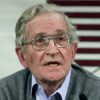
Noam Chomsky
Avram Noam Chomskyis an American linguist, philosopher, cognitive scientist, historian, logician, social critic, and political activist. Sometimes described as "the father of modern linguistics", Chomsky is also a major figure in analytic philosophy, and one of the founders of the field of cognitive science. He has spent more than half a century at the Massachusetts Institute of Technology, where he is Institute Professor Emeritus, and is the author of over 100 books on topics such as linguistics, war, politics, and...
NationalityAmerican
ProfessionTeacher
Date of Birth7 December 1928
CityPhiladelphia, PA
CountryUnited States of America
Israelis would mostly breathe a sigh of relief if Palestinians were to disappear.
Everyone who is critical of Israeli policy is deluged by crazed messages intended to flood their email system or, more insidiously, passwords are accessed and messages sent out under their name! I'm sure it's illegal. It's also an effort to undermine free speech.
In September 1993, President Clinton presided over a handshake between Israeli Prime Minister Yitzhak Rabin and Palestine Liberation Organization Chairman Yasser Arafat on the White House lawn - the climax of a 'day of awe,' as the press described it.
In November 2008, the day of the presidential election, Israeli military forces invaded Gaza and killed half a dozen Hamas militants. Well, that was followed by a missile exchange for a couple of weeks in both directions.
The list of U.S. vetoes at the Security Council to protect Israeli aggression and occupation is huge.
In Egypt, on the eve of Tahrir Square, there was a major poll which found that overwhelmingly - 80-90%, numbers like that - Egyptians regarded the main threats they face as the U.S. and Israel. They don't like Iran - Arabs generally don't like Iran - but they didn't consider it a threat.
In February 2004, the two traditional torturers of Haiti - France and the United States - combined to back a military coup and send President Aristide off to Africa. The U.S. denies him permission to return to the entire region.
In general, I think, U.S. policies remain constant, going back to the Second World War. But the capacity to implement them is declining.
In 1963, the U.N. Security Council declared a voluntary arms embargo on South Africa. That was extended to a mandatory embargo in 1977. And that was followed by economic sanctions and other measures - sometimes officials, countries, cities, towns - some organized by popular movements.
In much of the world, there is a sense of an ultra-powerful CIA manipulating everything that happens, such as running the Arab Spring, running the Pakistani Taliban, etc. That is just nonsense.
In Kosovo, the U.S. has chosen a course of action that escalates atrocities and violence. It is also a course of action that strikes a blow against the regime of international order, but which offers the weak at least some protection from predatory states.
In Latin America, specialists and polling organisations have, for some time, observed that the extension of formal democracy was accompanied by an increasing disillusionment about democracy and a lack of faith in democratic institutions.
Immediately after 11 September, the U.S. closed down the Somali charitable network Al-Barakaat on grounds that it was financing terror. This achievement was hailed one of the great successes of the 'war on terror.' In contrast, Washington's withdrawal of its charges as without merit a year later aroused little notice.
Egypt is the second-largest recipient over a long period of U.S. military and economic aid. Israel is first.