Neil deGrasse Tyson
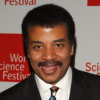
Neil deGrasse Tyson
Neil deGrasse Tysonis an American astrophysicist, cosmologist, author, and science communicator. Since 1996, he has been the Frederick P. Rose Director of the Hayden Planetarium at the Rose Center for Earth and Space in New York City. The center is part of the American Museum of Natural History, where Tyson founded the Department of Astrophysics in 1997 and has been a research associate in the department since 2003...
NationalityAmerican
ProfessionScientist
Date of Birth5 October 1958
CountryUnited States of America
There are a lot of things you can do in space, and space essentially is unlimited resources. We are climbing over ourselves here looking for the next source of energy. The universe has an unlimited source of energy.
I was transformed by picking up a pair of binoculars and looking up, and that's hard to do for a city kid because when you look up you just see buildings - and really, your first thought is to look in people's windows. So to look out of the space - out of living space - and look up to the sky, binoculars go far, literally and figuratively.
I don't care what town you're born in, what city, what country. If you're a child, you are curious about your environment. You're overturning rocks. You're plucking leaves off of trees and petals off of flowers, looking inside, and you're doing things that create disorder in the lives of the adults around you.
The partisanship surrounding space exploration and the retrenching of U.S. space policy are part of a more general trend: the decline of science in the United States. As its interest in science wanes, the country loses ground to the rest of the industrialized world in every measure of technological proficiency.
The problem is that many people operate on the assumption that NASA should go to Congress every year with hat in hand and justify it every year. Well, I see it as the greatest economic driver that there ever was. Economic drivers don't need justification.
Every day, I wake up and I say, 'Why... how... did I end up with 1.7 million Twitter followers?' It's freaky to me, every day, but that tells me that there's an appetite out there that had previously been underserved. There's an inner geek in us all, an inner bit of curiosity that people are discovering, and they like it.
You can't come away with this cosmic perspective thinking that you are better than others and want to fight. That's why you'll never have astrophysicists leading nations into war.
One of my great laments is that education today seems to have... be less about passion and more about process, more about tactic or technique.
Pluto's orbit is so elongated that it crosses the orbit of another planet. Now that's... you've got no business doing that if you want to call yourself a planet. Come on, now! There's something especially transgressive about that.
If we find life out there, and it's not us, we will deem it not intelligent. But what may be equally as likely is that we find life that's vastly more intelligent than we are. If that's the case, we are putty in their hands.
Some asteroids have us in their sights. Be nice to sort of go near them and find out what they're made of, possibly tag their ears so they're always broadcasting to us their location. In case one of their trajectories head straight for us, we'll know well in advance to do something about it.
Let's find a new way to think about the entire taxonomy of solar system objects, and not clutch to this concept of 'planet,' which, of course, only ever meant, 'Do you move against the background stars, regardless of what you're made of?'
When you put money directly to a problem, it makes a good headline. It makes a good campaign slogan. You get to claim that you've engaged in these activities within an election cycle. But certain investments take longer than an election cycle.
There are thousands of asteroids whose orbit in the Solar System crosses that of Earth. And we have a little acronym for them - NEOs: near Earth objects. And our biggest goal is to try to catalogue them, so we know in advance if one is going to put us at risk.