Moses
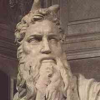
Moses
Mosesis a prophet in Abrahamic religions. According to the Hebrew Bible, he was a former Egyptian prince who later in life became a religious leader and lawgiver, to whom the authorship of the Torah is traditionally attributed. Also called Moshe Rabbenu in Hebrew, he is the most important prophet in Judaism. He is also an important prophet in Christianity, Islam, Baha'ism as well as a number of other faiths...
ProfessionClergyman
fall ignorance thinking
Consciousness of myself, combined with complete ignorance of everything that does not fall within my sphere of thinking, is the most telling proof of my substantiality outside God, of my original existence
revelations salvation judaism
Judaism boasts of no exclusive revelation of eternal truths that are indispensable to salvation, of no revealed religion in the sense in which that term is usually understood.
thinking play care
Socrates didn't care to visit the theater, as a rule, except when the plays of Euripides (which some think, he himself had helped to compose), were performed.
legislation one-thing
Revealed religion is one thing, revealed legislation, another.
church mosques may
Reader! To whatever visible church, synagogue, or mosque you may belong! See if you do not find more true religion among the host of the excommunicated than among the far greater host who excommunicated them.
pieces eternity
Time is a part of eternity, and of the same piece with it.
law judaism jew
Judaism was not a religion but a law.
art father long
When Socrates was about 30, and his father was long dead, he was still pursuing the art of sculpture, but from necessity, and without much inclination.
profit theory process
The principal axiom in their theory was: Everything can be proved, and everything can be disproved; and in the process, one must profit as much from the folly of others, and from his own superiority, as he can.
men order friendly
Socrates' fame spread all over Greece, and the most respected and educated men from all around came to him, in order to enjoy his friendly company and instruction.
thinking together able
We would be able neither to remember nor to reflect nor to compare nor to think, indeed, we would not even be the person who we were a moment ago, if our concepts were divided among many and were not to be encountered somewhere together in their most exact combination.
law giving needs
The state dictates and coerces; religion teaches and persuades. The state enacts laws; religion gives commandments. The state is armed with physical force and makes use of it if need be; the force of religion is love and benevolence.
use states beneficence
The state has physical power and uses it when necessary; the power of religion is love and beneficence
matter philosopher debate
I fear that, in the end, the famous debate among materialists, idealists, and dualists amounts to a merely verbal dispute that is more a matter for the linguist than for the speculative philosopher