Milan Kundera
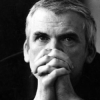
Milan Kundera
Milan Kunderais a Czech-born writer who went into exile in France in 1975, and became a naturalised French citizen in 1981. He "sees himself as a French writer and insists his work should be studied as French literature and classified as such in book stores"...
NationalityCzechoslovakian
ProfessionWriter
Date of Birth1 April 1929
courage law coincidence-in-life
Without realizing it, the individual composes his life according to the laws of beauty even in times of greatest distress.
discovery criticism critics
Let us consider the critic, therefore, as a discoverer of discoveries.
people feelings common
Nothing is more repugnant to me than brotherly feelings grounded in the common baseness people see in one another.
rehearsal firsts unbearable
And what can life be worth if the first rehearsal for life is life itself?
eye past glances
We pass through the present with our eyes blindfolded. We are permitted merely to sense and guess at what we are actually experiencing. Only later when the cloth is untied can we glance at the past and find out what we have experienced and what meaning it has.
men people fellow-man
People derived too much pleasure from seeing their fellow man morally humiliated to spoil that pleasure by hearing out an explanation.
sleep gone nightmare
Tereza had gone back to sleep; he could not. He pictured her death. She was dead and having terrible nightmares; but because she was dead, he was unable to wake her from them. Yes, that is death: Tereza asleep, having terrible nightmares, and he unable to wake her.
dog animal law
Dogs do not have many advantages over people, but one of them is extremely important: euthanasia is not forbidden by law in their case; animals have the right to a merciful death.
vocabulary together too-late
Perhaps if they had stayed together longer, Sabina and Franz would have begun to understand the words they used. Gradually, timorously, their vocabularies would have come together, like bashful lovers, and the music of one would have begun to intersect with the music of the other. But it was too late now.
world confession traps
The novel is not the author's confession; it is an investigation of human life in the trap the world has become
memories flower past
Remembering our past, carrying it around with us always, may be the necessary requirement for maintaining, as they say, the wholeness of the self. To ensure that the self doesn’t shrink, to see that it holds on to its volume, memories have to be watered like potted flowers, and the watering calls for regular contact with the witnesses of the past, that is to say, with friends. They are our mirror; our memory; we ask nothing of them but that they polish the mirror from time to time so we can look at ourselves in it.
character self empathy
All novels . . . are concerned with the enigma of the self. As soon as you create an imaginary being, a character, you are automatically confronted by the question: what is the self? How can it be grasped?
wise daughter mother
Her kitsch was the image of home, all peace, quiet, and harmony, and ruled by a loving mother and a wise father. It was an image that took shape in her after the death of her parents. The less her life resembled the sweetest of dreams, the more sensitive she was to its magic, and more than once she shed tears when the ungrateful daughter in a sentimental film embraced the neglected father as the windows of the happy family's house shone out into the dying day.
children moving infancy
Children are the future, because mankind is moving more and more towards infancy.