Michael Chertoff
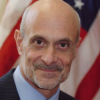
Michael Chertoff
Michael Chertoffis an American attorney who was the second United States Secretary of Homeland Security under Presidents George W. Bush andBarack Obama, and co-author of the USA PATRIOT Act. He previously served as a judge on the United States Court of Appeals for the Third Circuit, as a federal prosecutor, and as Assistant U.S. Attorney General. He succeeded Tom Ridge as United States Secretary of Homeland Security on February 15, 2005...
NationalityAmerican
ProfessionPublic Servant
Date of Birth28 November 1953
CountryUnited States of America
There really is no vacation from the world in which we live.
The fact that we have not had a terrorist attack in this country in the last six years is not a cause for complacency or a time to celebrate the end of the struggle. The threat is not going away. The enemy has not lost interest. ...Fundamentally, we're in a struggle about ideology. Terrorists want to remake the world in their own image and it is the image that is intolerant of the kinds of institutions that we cherish.
So people have to decide. Do they want to have the security? Do they want to continue to plug the gap [in border security] that GAO has identified and recognize that there will be some costs to doing that? Or do we want to make sure that business isn't hampered and that people can move back and forth readily, and recognize that, if we don't put some barriers in place, we're going to wind up with dangerous people coming into the country?
But one thing that we have done in the last four years is we have really put pressure on the leadership of this organization [Al Qaeda]. We have killed a significant number of leaders. We've captured others. Those that remain have to look over their shoulders, they have to be on the run. So that even if we don't manage to kill or capture them all within four years, what we do do is put the kind of pressure on them that makes them focus on their own skins, as opposed to carrying out attacks.
We now have capabilities in science and technology that raise the very realistic possibility that a small group of terrorists could kill not only thousands of people, as they did on September 11th, but hundreds of thousands of people. And that has changed the dimension of the threat we face.
I think the idea that you can go this alone is - was a huge mistake. And unfortunately, there was a price paid in terms of suffering and pain for people in New Orleans.
And I have to say, I agree with some of the criticisms that some have made about that state program which allocates the grant money on a very rigid formula all across the country, with a certain percentage to each state.
You don't bargain with terrorists. You don't appease terrorists. And anybody who believes that this is about something we've done has to ask themselves why it is, on September 11, 2001, before we were in Afghanistan, before we were in Iraq, he committed a dastardly attack killing over 3,000 people. I mean, this is not a matter of negotiation; it's a matter of victory.
I'm sometimes asked why it is that for 30 years we seem to have trouble in the United States enforcing the rules against illegal immigration, and I'll tell you what the answer is. The answer is that when the television cameras turn off and the spotlight moves to something else, there are a host of interest groups and advocacy groups who work very, very hard to make it difficult to enforce these rules. I'm not commenting adversely on their motivation, but I can tell you the effect of all of this is to wear down the ability of an agency to enforce the law....
The second thing we did was said, OK, we've now identified the risk, but what do you want to do with the money? Because it's not enough to have risk; you've got to have a meaningful use for the money we give you.
And it seems to me correct then, and I think it's correct now, that job one is get the planning done, make sure the buses are there. When that's done, it's completely appropriate to go around and tour around and look at the damage.
Al Qaeda is very media-savvy and very focused on what goes on in the global media.
First, we did rank everybody by risk, and New York comes out number one.
So that's why I said, if you look at the average, you would see the money New York got this year was in line with the average across the prior three years and substantially more, by a country mile, than the money given to any other city.