Leonardo da Vinci
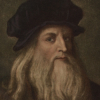
Leonardo da Vinci
Leonardo di ser Piero da Vinci, more commonly Leonardo da Vinci or simply Leonardoˈvintʃi] ; 15 April 1452 – 2 May 1519), was an Italian polymath whose areas of interest included invention, painting, sculpting, architecture, science, music, mathematics, engineering, literature, anatomy, geology, astronomy, botany, writing, history, and cartography. He has been variously called the father of paleontology, ichnology, and architecture, and is widely considered one of the greatest painters of all time. Sometimes credited with the inventions of the parachute, helicopter and tank,...
NationalityItalian
ProfessionPainter
Date of Birth15 April 1452
CityVinci, Italy
CountryItaly
It should not be hard for you to stop sometimes and look into the stains of walls, or ashes of a fire, or clouds, or mud or like places, in which...you may find really marvellous ideas.
In an atmosphere of uniform density the most distant things seen through it, such as the mountains, in consequence of the great quantity of atmosphere which is between your eye and them, will appear blue. Therefore you should make the building... wall which is more distant less defined and bluer... five times as far away, make five times as blue.
You should look at certain walls stained with damp, or at stones of uneven color. If you have to invent some backgrounds you will be able to see in these the likeness of divine landscapes, adorned with mountains, ruins, rocks, woods, great plains, hills and valleys in great variety; and expressions of faces and clothes and an infinity of things which you will be able to reduce to their complete and proper forms. In such walls the same thing happens as in the sound of bells, in whose stroke you may find every named word which you can imagine.
When you look at a wall spotted with stains...you may discover a resemblance to various landscapes, beautiful with mountains, rivers, rocks, trees. Or again, you may see battles and figures in action, or strange faces and costumes, and an endless variety of objects which you could reduce to complete and well-drawn figures.
No member needs so great a number of muscles as the tongue; this exceeds all the rest in the number of its movements
There shall be wings! If the accomplishment be not for me, 'tis for some other.
The most praiseworthy form of painting is one that most resembles what it imitates.
Nothing can be love or hated unless it is first known.
Obstacles cannot crush me; every obstacle yields to stern resolve.
Experience does not ever err; it is only your judgment that errs in promising itself results which are not caused by your experiments
When once you have tasted flight, you will forever walk the earth with your eyes turned skyward, for there you have been, and there you will always long to return.
The painter who is familiar with the nature of the sinews, muscles, and tendons, will know very well, in giving movement to a limb, how many and which sinews cause it; and which muscle, by swelling, causes the contraction of that sinew; and which sinews, expanded into the thinnest cartilage, surround and support the said muscle.
The mind of the painter must resemble a mirror, which always takes the colour of the object it reflects and is completely occupied by the images of as many objects as are in front of it.
Our body is dependant on Heaven and Heaven on the Spirit.