Leonardo da Vinci
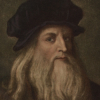
Leonardo da Vinci
Leonardo di ser Piero da Vinci, more commonly Leonardo da Vinci or simply Leonardoˈvintʃi] ; 15 April 1452 – 2 May 1519), was an Italian polymath whose areas of interest included invention, painting, sculpting, architecture, science, music, mathematics, engineering, literature, anatomy, geology, astronomy, botany, writing, history, and cartography. He has been variously called the father of paleontology, ichnology, and architecture, and is widely considered one of the greatest painters of all time. Sometimes credited with the inventions of the parachute, helicopter and tank,...
NationalityItalian
ProfessionPainter
Date of Birth15 April 1452
CityVinci, Italy
CountryItaly
No member needs so great a number of muscles as the tongue; this exceeds all the rest in the number of its movements
The human being, creature of eyes, needs the image.
Here is a thing which the more it is needed the more it is rejected: and this is advice, which is unwillingly heeded by those who most need it, that is to say, by the ignorant.
Every action needs to be prompted by a motive.
There is no result in nature without a cause; understand the cause and you will have no need of the experiment.
When once you have tasted flight, you will forever walk the earth with your eyes turned skyward, for there you have been, and there you will always long to return.
Experience does not ever err; it is only your judgment that errs in promising itself results which are not caused by your experiments
Obstacles cannot crush me; every obstacle yields to stern resolve.
Nothing can be love or hated unless it is first known.
The eye sees a thing more clearly in dreams than the imagination awake.
Just as eating contrary to the inclination is injurious to the health, so study without desire sports the memory, and it retains nothing that it takes in.
Iron rusts from disuse; water loses its purity from stagnation ... even so does inaction sap the vigour of the mind.
Iron rusts from disuse, stagnant water loses its purity and in cold weather becomes frozen; even so does inaction sap the vigors of the mind.
Iron rusts from disuse, stagnant water loses its purity, and in cold weather becomes frozen, even so does inaction sap the vigors of the mind.