Jiddu Krishnamurti
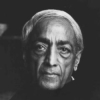
Jiddu Krishnamurti
Jiddu Krishnamurtiwas a speaker and writer on matters that concerned humankind. In his early life he was groomed to be the new World Teacher but later rejected this mantle and withdrew from the organization behind it. His subject matter included psychological revolution, the nature of mind, meditation, inquiry, human relationships, and bringing about radical change in society. He constantly stressed the need for a revolution in the psyche of every human being and emphasised that such revolution cannot be brought...
NationalityIndian
ProfessionPhilosopher
Date of Birth12 May 1895
CountryIndia
The ability to observe without evaluating is the highest form of intelligence.
That is the first thing to learn — not to seek. When you seek you are really only window-shopping. The question of whether or not there is a God or truth or reality, or whatever you like to call it, can never be answered by books, by priests, philosophers or saviours. Nobody and nothing can answer the question but you yourself and that is why you must know yourself. Immaturity lies only in total ignorance of self. To understand yourself is the beginning of wisdom.
The man who lives without conflict, who lives with beauty and love, is not frightened of death because to love is to die.
There is an efficiency inspired by love which goes far beyond and is much greater than the efficiency of ambition; and without love, which brings an integrated understanding of life, efficiency breeds ruthlessness. Is this not what is actually taking place all over the world? Our present education is geared to industrialization and war, its principal aim being to develop efficiency; and we are caught in this machine of ruthless competition and mutual destruction. If education leads to war, if it teaches us to destroy or be destroyed, has it not utterly failed?
The moment you venture out, something takes place in you and about you. Life comes to your aid in various ways. You may not like the form in which it comes to you - it may be misery, struggle, starvation - but when you invite life, things begin to happen.
If I want to understand something, I must observe, I must not criticize, I must not condemn, I must not pursue it as pleasure or avoid it as non-pleasure. There must merely be the silent observation of a fact.
The idea, the pattern, is self-projected; it is a form of self-worship, of self-perpetuation, and hence gratifying.
Live with it. You live with pleasure, don't you? Why don't you live with suffering completely? Can you live with it in the sense of not escaping from it? What takes place? Watch. The mind is very clear, sharp. It is faced with the fact. The very suffering transformed into passion is enormous. From that arises a mind that can never be hurt. Full stop. That is the secret.
All outward forms of change brought about by wars, revolutions, reformations, laws and ideologies have failed completely to change the basic nature of man and therefore of society.
Meditation is not the pursuit of an invisible path leading to some imaginal bliss. The meditative mind is seeing, watching, listening, without the word, without comment, without opinion, attentive to the movement of life in all its relationships throughout the day.
You know, in the case of most of us, the mind is noisy, everlastingly chattering to itself , soliloquizing or chattering about something, or trying to talk to itself, to convince itself of something; it is always moving, noisy.
In this country, unfortunately, as all over the world, we care so little, we have no deep feeling about anything. Most of us are intellectual-intellectuals in the superficial sense of being very clever, full of words and theories about what is right and what is wrong, about how we should think, what we should do. Mentally we are highly developed, but inwardly there is very little substance or significance; and it is this inward substance that brings about true action, which is not action according to an idea.
After all, conflict arises, does it not, through the desire to be something, to be other than what is.
Thought is matter as much as the floor, the wall, the telephone, are matter.