Jiddu Krishnamurti
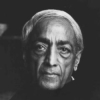
Jiddu Krishnamurti
Jiddu Krishnamurtiwas a speaker and writer on matters that concerned humankind. In his early life he was groomed to be the new World Teacher but later rejected this mantle and withdrew from the organization behind it. His subject matter included psychological revolution, the nature of mind, meditation, inquiry, human relationships, and bringing about radical change in society. He constantly stressed the need for a revolution in the psyche of every human being and emphasised that such revolution cannot be brought...
NationalityIndian
ProfessionPhilosopher
Date of Birth12 May 1895
CountryIndia
And the fear of not being is born in that space. But in meditation, when this is understood, the mind can enter into a dimension of space where action is inaction. We do not know what love is, for in the space made by thought around itself as the me, love is the conflict of the me and the not-me. This conflict, this torture, is not love. Thought is the very denial of love, and it cannot enter into that space where the me is not. In that space is the benediction which man seeks and cannot find. He seeks it within the frontiers of thought, and thought destroys the ecstasy of this benediction.
The ending is the beginning, and the beginning is the first step, and the first step is the only step.
If your eyes are blinded with your worries, you cannot see the beauty of the sunset.
When you identify yourself with a group of people or a set of ideas, aren't you separating yourself?
If we try to listen we find it extraordinarily difficult, because we are always projecting our opinions and ideas, our prejudices, our background, our inclinations, our impulses; when they dominate, we hardly listen at all to what is being said...One listens and therefore learns, only in a state of silence, in which this whole background is in abeyance, is quite; then, it seems to me, it is possible to communicate
Here is my secret: I don't mind what happens.
Belief creates its own experience; therefore, such an experience is not true.
When I analyse myself and my reactions or behaviour, there is the act and the actor. There is a division between the two and that creates conflict between "what is" and "what should be".
There are two kinds of freedom: one is the freedom from something, which is a reaction; and the other is not a reaction, it is "being free."
As long as you ask questions you are breaking through, but the moment you begin to accept, you are psychologically dead. So right through life don't accept a thing, but inquire, investigate. Then you will find that your mind is something really extraordinary, it has no end, and to such a mind there is no death.
To understand what is right meditation there must be an awareness of the operation of one's own consciousness, and then there is complete attention.
Each breath is transforming me into thine image.
Is it possible to observe without the observer?
Sentimentality and emotionalism have nothing whatsoever to do with love.