Jiddu Krishnamurti
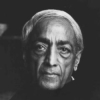
Jiddu Krishnamurti
Jiddu Krishnamurtiwas a speaker and writer on matters that concerned humankind. In his early life he was groomed to be the new World Teacher but later rejected this mantle and withdrew from the organization behind it. His subject matter included psychological revolution, the nature of mind, meditation, inquiry, human relationships, and bringing about radical change in society. He constantly stressed the need for a revolution in the psyche of every human being and emphasised that such revolution cannot be brought...
NationalityIndian
ProfessionPhilosopher
Date of Birth12 May 1895
CountryIndia
A dialogue is very important. It is a form of communication in which question and answer continue till a question is left without an answer. Thus the question is suspended between the two persons involved in this answer and question. It is like a bud with untouched blossoms . . . If the question is left totally untouched by thought, it then has its own answer because the questioner and answerer, as persons, have disappeared. This is a form of dialogue in which investigation reaches a certain point of intensity and depth, which then has a quality that thought can never reach.
To be free of all authority, of your own and that of another, is to die to everything of yesterday, so that your mind is always fresh, always young, innocent, full of vigour and passion. It is only in that state that one learns and observes. And for this, a great deal of awareness is required, actual awareness of what is going on inside yourself, without correcting it or telling it what it should or should not be, because the moment you correct it you have established another authority, a censor.
Begin where you are. Read every word, every phrase, every paragraph of the mind, as it operates through thought.
To understand life is to understand ourselves, and that is both the beginning and the end of education.
Love is a state of being, and in that state, the 'me', with its identifications, anxieties, and possessions is absent. Love cannot be, as long as the activities of the self, of the 'me', whether conscious or unconscious, continue to exist.
We are very defensive, and therefore aggressive, when we hold on to a particular belief, a dogmas, or when we worship our particular nationality, with the rag that is called the flag.
You only learn when you give your whole being to something. When you give your whole being to mathematics,you learn; but when you are in a state of contradiction, when you do not want to learn but are forced to learn, then it becomes merely a process of accumulation. To learn is like reading a novel with innumerable characters; it requires your full attention, not contradictory attention.
The world is not something separate from you and me; the world, society, is the relationship that we establish or seek to establish between each other. So you and I are the problem, and not the world, because the world is the projection of ourselves, and to understand the world we must understand ourselves. That world is not separate from us; we are the world, and our problems are the world's problems.
There is no ideal in observation. When you have an ideal, you cease to observe, you are then merely approximating the present to the idea, and therefore there is duality, conflict, and all the rest of it. The mind has to be in the state when it can see, observe. The experience of the observation is really an astonishing state. In that there is no duality. The mind is simply - aware.
Are you trying to grasp the quality of intelligence, compassion, the immense sense of beauty, the perfume of love and that truth which has no path to it?
A man who says, 'I want to change, tell me how to', seems very earnest, very serious, but he is not. He wants an authority whom he hopes will bring about order in himself. But can authority ever bring about inward order? Order imposed from without must always breed disorder.
do it or don't do it but get on with it...
The authority of a belief imposed by religion surely destroys the discovery of reality.One relies on authority because one is afraid to stand alone.
Look at that battle you are involved in; you are caught in it: you are it.