James Madison
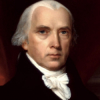
James Madison
James Madison, Jr.was a political theorist, American statesman, and the fourth President of the United States. He is hailed as the "Father of the Constitution" for his pivotal role in drafting and promoting the U.S. Constitution and the Bill of Rights...
NationalityAmerican
ProfessionUS President
Date of Birth16 March 1751
CityPort Conway, VA
CountryUnited States of America
country eye justice
The eyes of the world being thus on our Country, it is put the more on its good behavior, and under the greater obligation also, to do justice to the Tree of Liberty by an exhibition of the fine fruits we gather from it.
government evil perfect
It has been said that all Government is an evil. It would be more proper to say that the necessity of any Government is a misfortune. This necessity however exists; and the problem to be solved is, not what form of Government is perfect, but which of the forms is least imperfect.
government independence fundamentals
On the distinctive principles of the Government ... of the U. States, the best guides are to be found in ... The Declaration of Independence, as the fundamental Act of Union of these States.
freedom animal agency
Liberty is to faction, what air is to fire, an aliment without which it instantly expires. But it could not be a less folly to abolish liberty, which is essential to political life, because it nourishes faction, than it would be to wish the annihilation of air, which is essential to animal life, because it imparts to fire its destructive agency.
government justice liberty
Justice is the end of government. It is the end of civil society. It ever has been and ever will be pursued until it be obtained, or until liberty be lost in the pursuit.
government names people
If we resort for a criterion to the different principles on which different forms of government are established, we may define a republic to be, or at least may bestow that name on, a government which derives all its powers directly or indirectly from the great body of the people, and is administered by persons holding their offices during pleasure for a limited period, or during good behavior.
government important may
It is a misfortune incident to republican government, though in a less degree than to other governments, that those who administer it, may forget their obligations to their constituents, and prove unfaithful to their important trust.
government debt goes-on
I go on the principle that a public debt is a public curse and in a republican government more than in any other.
exercise giving people
What is to be the consequence, in case the Congress shall misconstrue this part [the necessary and proper clause] of the Constitution and exercise powers not warranted by its true meaning, I answer the same as if they should misconstrue or enlarge any other power vested in them . . . the success of the usurpation will depend on the executive and judiciary departments, which are to expound and give effect to the legislative acts; and in a last resort a remedy must be obtained from the people, who can by the elections of more faithful representatives, annul the acts of the usurpers.
mean giving separation
[T]he great security against a gradual concentration of the several powers in the same department consists in giving to those who administer each department the necessary constitutional means and personal motives to resist encroachment of the others.
happiness safety political
The safety and happiness of society are the objects at which all political institutions aim, and to which all such institutions must be sacrificed.
real lying government-lies
Wherever the real power in a Government lies, there is the danger of oppression.
war preparation establishment
How could a readiness for war in time of peace be safely prohibited, unless we could prohibit, in like manner, the preparations and establishments of every hostile nation?
imagination visionaries events
A universal peace, it is to be feared, is in the catalogue of events, which will never exist but in the imaginations of visionary philosophers, or in the breasts of benevolent enthusiasts.