James Bryant Conant
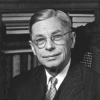
James Bryant Conant
James Bryant Conantwas an American chemist, a transformative President of Harvard University, and the first U.S. Ambassador to West Germany. Conant obtained a PhD in Chemistry from Harvard in 1916. During World War I he served in the U.S. Army, working on the development of poison gases. He became an assistant professor of chemistry at Harvard in 1919, and the Sheldon Emery Professor of Organic Chemistry in 1929. He researched the physical structures of natural products, particularly chlorophyll, and he...
NationalityAmerican
ProfessionScientist
Date of Birth26 March 1893
CountryUnited States of America
James Bryant Conant quotes about
... scientific research is compounded of ... empirical procedures, general speculative ideas, and mathematical or abstract reasoning.
A conceptual scheme is never discarded merely because of a few stubborn facts with which it cannot be reconciled; a conceptual scheme is either modified or replaced by a better one, never abandoned with nothing left to take its place.
Diversity of opinion within the framework of loyalty to our free society is not only basic to a university but to the entire nation.
Therefore, a grotesque account of a period some thousands of years ago is taken seriously though it be built by piling special assumptions on special assumptions, ad hoc hypothesis [invented for a purpose] on ad hoc hypothesis, and tearing apart the fabric of science whenever it appears convenient. The result is a fantasia which is neither history nor science.
Behavior which appears superficially correct but is intrinsically corrupt always irritates those who see below the surface.
Whether a man lives or dies in vain can be measured only by the way he faces his own problems, by the success or failure of the inner conflict within his own soul. And of this no one may know save God.
A Harvard education consists of what you learn at Harvard while you are not studying.
Education is what is left after all that has been learnt is forgotten.
The stumbling way in which even the ablest of the scientists in every generation have had to fight through thickets of erroneous observations, misleading generalizations, inadequate formulation, and unconscious prejudice is rarely appreciated by those who obtain their scientific knowledge from textbooks.
I venture to define science as a series of interconnected concepts and conceptual schemes arising from experiment and observation and fruitful of further experiments and observations. The test of a scientific theory is, I suggest, its fruitfulness.
Just like a turtle, we only make progress if we stick our neck out.
Behold the turtle. He makes progress only when he sticks his neck out.