Friedrich Nietzsche
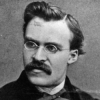
Friedrich Nietzsche
Friedrich Wilhelm Nietzschewas a German philosopher, cultural critic, poet and Latin and Greek scholar whose work has exerted a profound influence on Western philosophy and modern intellectual history. He began his career as a classical philologist before turning to philosophy. He became the youngest ever to hold the Chair of Classical Philology at the University of Basel in 1869, at the age of 24. Nietzsche resigned in 1879 due to health problems that plagued him most of his life, and...
NationalityGerman
ProfessionPhilosopher
Date of Birth15 October 1844
CityRocken, Germany
CountryGermany
A married philosopher belongs to comedy.
To the mean all becomes mean.
He who is not a bird should not build his nest over abysses.
There is a universal need to exercise some kind of power, or to create for one's self the appearance of some power, if only temporarily, in the form of intoxication.
Every high degree of power always involves a corresponding degree of freedom from good and evil.
The man who sees little always sees less than there is to see; the man who hears badly always hears something more than there is to hear.
The poet presents his thoughts festively, on the carriage of rhythm: usually because they could not walk.
The great poet draws his creations only from out of his own reality.
Enjoyment and innocence are the most bashful things: both do not want to be sought.
A refined nature is vexed by knowing that some one owes it thanks, a coarse nature by knowing that it owes thanks to some one.
As soon as we are shown the existence of something old in a new thing, we are pacified.
A nation usually renews its youth on a political sick-bed, and there finds again the spirit which it had gradually lost in seeking and maintaining power.
To produce music is also in a sense to produce children.
We are doubly willing to jump into the water after some one who has fallen in, if there are people present who have not the courage to do so.