Friedrich Nietzsche
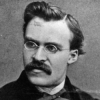
Friedrich Nietzsche
Friedrich Wilhelm Nietzschewas a German philosopher, cultural critic, poet and Latin and Greek scholar whose work has exerted a profound influence on Western philosophy and modern intellectual history. He began his career as a classical philologist before turning to philosophy. He became the youngest ever to hold the Chair of Classical Philology at the University of Basel in 1869, at the age of 24. Nietzsche resigned in 1879 due to health problems that plagued him most of his life, and...
NationalityGerman
ProfessionPhilosopher
Date of Birth15 October 1844
CityRocken, Germany
CountryGermany
I cook every chance in my pot. And only when it is cooked through do I welcome it as my food.
One is honest about oneself either with a sense of shame or with vanity.
What does a philosopher demand of himself, first and last? To overcome his time in himself, to become "timeless.
The rights a man arrogates to himself are related to the duties he imposes on himself, to the tasks to which he feels equal. The great majority of men have no right to existence, but are a misfortune to higher men.
It is possible to imagine a society flushed with such a sense of power that it could afford to let its offenders go unpunished.
Art furnishes us with eyes and hands and above all the good conscience to be able to turn ourselves into such a phenomenon.
Unpleasant, even dangerous, qualities can be found in every nation and every individual: it is cruel to demand that the Jew be an exception. In him, these qualities may even be dangerous and revolting to an unusual degree; and perhaps the young stock-exchange Jew is altogether the most disgusting invention of mankind.
How can a man know himself? He is a thing dark and veiled; and if the hare has seven skins, man can slough off seventy times seven and still not be able to say: "this is really you, this is no longer outer shell.
Our vanity would have just that which we do best count as that which is hardest for us. The origin of many a morality.
A declaration of war on the masses by higher men is needed! ... Everything that makes soft and effeminate, that serves the end of the people or the feminine, works in favor of universal suffrage, i.e. the domination of the inferior men. But we should take reprisal and bring this whole affair to light and the bar of judgment.
The beautiful exists just as little as the true. In every case it is a question of the conditions of preservation of a certain type of man: thus the herd-man will experience the value feeling of the true in different things than will the overman.
When one gives up Christian belief one thereby deprives oneself of the right to Christian morality. For the latter is absolutely not self-evident: one must make this point clear again and again, in spite of English shallowpates.
We want to be poets of our life first of all in the smallest most everyday matters.
We often contradict an opinion for no other reason than that we do not like the tone in which it is expressed.