Friedrich Nietzsche
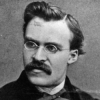
Friedrich Nietzsche
Friedrich Wilhelm Nietzschewas a German philosopher, cultural critic, poet and Latin and Greek scholar whose work has exerted a profound influence on Western philosophy and modern intellectual history. He began his career as a classical philologist before turning to philosophy. He became the youngest ever to hold the Chair of Classical Philology at the University of Basel in 1869, at the age of 24. Nietzsche resigned in 1879 due to health problems that plagued him most of his life, and...
NationalityGerman
ProfessionPhilosopher
Date of Birth15 October 1844
CityRocken, Germany
CountryGermany
Among twelve apostles there must always be one who is as hard as stone, so that the new church may be built upon him.
It is only when we have ceased to be the followers of our followers that we comprehend how meaningless followers are.
Many a peacock hides his peacock tail from all eyes--and calls it his pride.
Truth is the kind of error without which a certain species of life could not live. The value for life is ultimately decisive.
Antithesis is the narrow gateway through which error most prefers to worm its way towards truth.
There will be but few people who, when at a loss for topics of conversation, will not reveal the more secret affairs of their friends.
Carlyle, a man of strong words and attitudes, a rhetorician out of necessity, constantly aroused by the craving for a strong faithas well as by the feeling of an incapacity for it (Min this respect a typical romantic!).... Fundamentally, Carlyle is an English atheist who makes it a point of honor not to be one.
The problem of culture is seldom grasped correctly. The goal of a culture is not the greatest possible happiness of a people, noris it the unhindered development of all their talents; instead, culture shows itself in the correct proportion of these developments. Its aim points beyond earthly happiness: the production of great works is the aim of culture.
The will to power can express itself only against resistances; it seeks that which resists it--this is the native tendency of theamoeba when it extends its pseudopodia and gropes around.
Our drives are reducible to the will to power. The will to power is the ultimate fact at which we arrive.
The grand style follows suit with all great passion. It disdains to please, it forgets to persuade. It commands. It wills.
Every word has its fragrance: there is a harmony and a disharmony of fragrances, and hence of words.
He who strays from the customary becomes a sacrifice to the extraordinary; he who keeps to the customary becomes its slave. He iscondemned to perish in either case.
To those human beings who are of any concern to me, I wish suffering, desolation, sickness, ill treatment, indignities, profound self-contempt, the torture of self-mistrust, and the wretchedness of the vanquished.