Friedrich Nietzsche
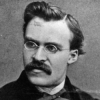
Friedrich Nietzsche
Friedrich Wilhelm Nietzschewas a German philosopher, cultural critic, poet and Latin and Greek scholar whose work has exerted a profound influence on Western philosophy and modern intellectual history. He began his career as a classical philologist before turning to philosophy. He became the youngest ever to hold the Chair of Classical Philology at the University of Basel in 1869, at the age of 24. Nietzsche resigned in 1879 due to health problems that plagued him most of his life, and...
NationalityGerman
ProfessionPhilosopher
Date of Birth15 October 1844
CityRocken, Germany
CountryGermany
The beating of drums, which delights young writers who serve a party, sounds to him who does not belong to the party line like a rattling of chains, and excites sympathy rather than admiration.
I will believe in the Redeemer when the Christians look a little more redeemed.
There are expressions and bulls-eyes of the spirit, there are epigrams, a little handful of words, in which a whole culture, a whole society is suddenly crystallized.
Their usual mistaken premise is that they affirm some consensus among people, at least among tame peoples, concerning certain moral principles, and then conclude that these principles must be unconditionally binding also for you and me-or conversely, they see that among different peoples moral valuations are necessarily different and infer from this that no morality is binding-both of which are equally childish.
I no longer want to walk on worn soles.
Some people throw a bit of their personality after their bad arguments, as if that might straighten their paths and turn them into right and good arguments-just as a man in a bowling alley, after he has let go of the ball, still tries to direct it with gestures.
One does well to put on gloves when reading the New Testament. The proximity of so much uncleanliness almost forces one to do this.
The view that honesty is something, and even a virtue, belongs, it is true, to those private opinions which are forbidden in this age of public opinions.
One who is publicly honest about himself ends up by priding himself somewhat on this honesty: for he knows only too well why he is honest-for the same reasons another person prefers illusion and dissimulation.
As much as possible, and this as quickly as possible: that is what the great mental and emotional illness craves that is variously called "present" or "culture," but that is actually a symptom of consumption.
People who, out of an inborn moderation, leave every glass standing only half-emptied refuse to admit that everything in the world has its sediments and dregs.
Subordination to morality can be slavish or vain or self- interested or resigned or gloomily enthusiastic or thoughtless or an act of despair, just as subordination to a prince can be: in itself it is nothing moral.
Verily, a polluted stream is man. One must actually be a sea to take in a polluted stream without becoming impure. Behold, I teach you the superman: he is the this sea, in him can your great contempt go under.
Great things demand that we either remain silent about them or speak in a great manner: in a great manner, that is-cynically and with innocence.