Friedrich Nietzsche
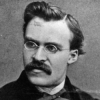
Friedrich Nietzsche
Friedrich Wilhelm Nietzschewas a German philosopher, cultural critic, poet and Latin and Greek scholar whose work has exerted a profound influence on Western philosophy and modern intellectual history. He began his career as a classical philologist before turning to philosophy. He became the youngest ever to hold the Chair of Classical Philology at the University of Basel in 1869, at the age of 24. Nietzsche resigned in 1879 due to health problems that plagued him most of his life, and...
NationalityGerman
ProfessionPhilosopher
Date of Birth15 October 1844
CityRocken, Germany
CountryGermany
The command 'become hard! ', the deep conviction that all creators are hard, is the really distinctive sign of a Dionysian nature.
The coward does not know what it means to be alone: an enemy is always standing behind his chair.
The consequence is that every man comes to know himself solely in terms of his power for defence and attack.
The noble man honours in himself the powerful one, him also who has power over himself, who knows how to speak and how to keep silence, who takes pleasure in subjecting himself to severity and hardness, and has reverence for all that is severe and hard.
It is the powerful who know how to honour, it is their art, their domain for invention.
Everything that is ponderous, vicious and pompously clumsy, all long-winded and wearying kinds of style, are developed in great variety among Germans.
How little is required for pleasure! The sound of a bagpipe - without music, life would be an error.
Only as an aesthetic product can the world be justified to all eternity.
Christianity has the rancor of the sick at its very core-the instinct against the healthy, against health. Everything that is well-constructed, proud, gallant and, above all, beautiful gives offense to its ears and eyes.
His (the theologian) basic instinct of self preservation forbids him to respect reality at any point or even to let it get a word in.
However un-Christian this may sound, I am not even predisposed against myself.
Nothing is more pathological in our pathological modernity than this disease of Christian pity.
What was a lie in the father becomes a conviction in the son.
One must have all the virtues to sleep well. Shall I bear false witness? Shall I commit adultery? Shall I covet my neighbor's maid? All that would go ill with good sleep.