Franklin D. Roosevelt
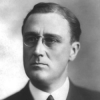
Franklin D. Roosevelt
Franklin Delano Roosevelt, commonly known as FDR, was an American statesman and political leader who served as the President of the United States from 1933 to 1945. A Democrat, he won a record four presidential elections and dominated his party after 1932 as a central figure in world events during the mid-20th century, leading the United States during a time of worldwide economic depression and total war. His program for relief, recovery and reform, known as the New Deal, involved...
NationalityAmerican
ProfessionUS President
Date of Birth30 January 1882
CityHyde Park, NY
CountryUnited States of America
Failure is not an American habit.
People die, but books never die. No man and no force can abolish memory.
It is time to extend planning to a wider field, in this instance comprehending in one great project many states directly concerned with the basin of one of our greatest rivers.
That is the spiral galaxy in Andromeda. It is as large as our Milky Way. It is one of a hundred million galaxies. It consists of one hundred billion suns. Now I think we are small enough.
As a nation, we may take pride in the fact that we are softhearted; but we cannot afford to be soft-headed.
I read in a newspaper that I was to be received with all the honors customarily rendered to a foreign ruler. I am grateful for the honors; but something within me rebelled at that word 'foreign'. I say this because when I have been in Canada, I have never heard a Canadian refer to an American as a 'foreigner'. He is just an 'American'. And, in the same way, in the United States, Canadians are not 'foreigners', they are 'Canadians'. That simple little distinction illustrates to me better than anything else the relationship between our two countries.
Many causes produce war. There are ancient hatreds, turbulent frontiers, the "legacy of old forgotten, far-off things, and battles long ago." There are new-born fanaticisms. Convictions on the part of certain peoples that they have become the unique depositories of ultimate truth and right.
More than an end to war, we want an end to the beginnings of all wars. Yes, an end to this brutal, inhuman and thoroughly impractical method of settling the differences between Governments. The once powerful malignant Nazi state is crumbling; the Japanese warlords are receiving in their homelands the retribution for which they asked when they attacked Pearl Harbor. But the mere conquest of our enemies is not enough; we must go on to do all in our power to conquer the doubts and the fears, the ignorance and the greed, which made this horror possible.
The royalists of the economic order have conceded that political freedom was the business of the government, but they have maintained that economic slavery was nobody's business. They granted that the government could protect the citizen in his right to vote, but they denied that the government could do anything to protect the citizen in his right to work and his right to live. Today we stand committed to the proposition that freedom is no half-and-half affair. If the average citizen is guaranteed equal opportunity in the polling place, he must have equal opportunity in the market place.
What worries me, especially, is that public opinion over here is patting itself on the back every morning and thanking God for theAtlantic Ocean (and the Pacific Ocean). We greatly underestimate the serious implications to our own future.... Things move with such terrific speed these days, that it is really essential to us to think in broader terms and, in effect, to warn the American people that they, too, should think of possible ultimate results in Europe and the Far East.
Chamberlain's visit to Hitler today may bring things to a head or may result in a temporary postponement of what looks to me likean inevitable conflict within the next five years.
The whole world is one neighborhood.
I've fired my last shot. I think I should have another round in my belt.
The only thing we have to fear...is audiovisual glitches at our annual event.