Carl Sagan
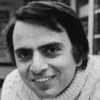
Carl Sagan
Carl Edward Saganwas an American astronomer, cosmologist, astrophysicist, astrobiologist, author, science popularizer, and science communicator in astronomy and other natural sciences. He is best known for his contributions to the scientific research of extraterrestrial life, including experimental demonstration of the production of amino acids from basic chemicals by radiation. Sagan assembled the first physical messages sent into space: the Pioneer plaque and the Voyager Golden Record, universal messages that could potentially be understood by any extraterrestrial intelligence that might find...
NationalityAmerican
ProfessionScientist
Date of Birth9 November 1934
CityBrooklyn, NY
CountryUnited States of America
What is called for is an exquisite balance between two conflicting needs: the most skeptical scrutiny of all hypotheses that are served up to us and at the same time a great openness to new ideas. If you are only skeptical, then no new ideas make it through to you. On the other hand, if you are open to the point of gullibility and have not an ounce of skeptical sense in you, then you cannot distinguish useful ideas from the worthless ones.
We are the first species to have taken our evolution into our own hands.
My deeply held belief is that if a god of anything like the traditional sort exists, our curiosity and intelligence are provided by such a god. We would be unappreciative of those gifts (as well as unable to take such a course of action) if we suppressed our passion to explore the universe and ourselves. On the other hand, if such a traditional god does not exist, our curiosity and our intelligence are the essential tools for managing our survival. In either case, the enterprise of knowledge is consistent with both science and religion, and is essential for the welfare of the human species.
We are at a crossroads in human history. Never before has there been a moment so simultaneously perilous and promising. We are the first species to have taken evolution into our own hands.
I have a foreboding of an America in my children's or grandchildren's time ... when awesome technological powers are in the hands of a very few, and no one representing the public interest can even grasp the issues; when the people have lost the ability to set their own agendas or knowledgeably question those in authority; when clutching our crystals and nervously consulting our horoscopes, our critical faculties in decline, unable to distinguish between what feels good and what's true, we slide, almost without noticing, back into superstitions and darkness.
A still more glorious dawn awaits / not a sunrise, but a galaxy-rise / a morning filled with 400 billion suns / the rising of the milky way
What distinguishes our species is thought. The cerebral cortex is in a way a liberation. We need no longer be trapped in the genetically inherited behavior patterns of lizards and baboons: territoriality and aggression and dominance hierarchies. We are each of us largely responsible for what gets put in to our brains. For what as adults we wind up caring for and knowing about. No longer at the mercy of the reptile brain we can change ourselves. Think of the possibilities.
Once we overcome our fear of being tiny, we find ourselves on the threshold of a vast and awesome Universe that utterly dwarfs — in time, in space, and in potential — the tidy anthropocentric proscenium of our ancestors.
We were wanderers from the beginning.
Maxwell's Equations have had a greater impact on human history than any ten presidents.
Goddard represented a unique combination of visionary dedication and technological brilliance. He studied physics because he needed physics to get to Mars. In reading the notebooks of Robert Goddard, I am struck by how powerful his exploratory and scientific motivations were - and how influental speculative ideas, even erroneous ones, can be on the shaping of the future.
The visions we offer our children shape the future.
The suppression of uncomfortable ideas may be common in religion or in politics, but it is not the path to knowledge, and there's no place for it in the endeavor of science. We do not know beforehand where fundamental insights will arise from about our mysterious and lovely solar system. The history of our study of our solar system shows us clearly that accepted and conventional ideas are often wrong, and that fundamental insights can arise from the most unexpected sources.
Those at too great a distance may, I am well are, mistake ignorance for perspective.