Blaise Pascal
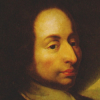
Blaise Pascal
Blaise Pascalwas a French mathematician, physicist, inventor, writer and Christian philosopher. He was a child prodigy who was educated by his father, a tax collector in Rouen. Pascal's earliest work was in the natural and applied sciences where he made important contributions to the study of fluids, and clarified the concepts of pressure and vacuum by generalising the work of Evangelista Torricelli. Pascal also wrote in defence of the scientific method...
NationalityFrench
ProfessionPhilosopher
Date of Birth19 June 1623
CityClermont-Ferrand, France
CountryFrance
If ignorance were bliss, he'd be a blister
If it is an extraordinary blindness to live without investigating what we are, it is a terrible one to live an evil life, while believing in God
The sum of a man's problems come from his inability to be alone in a silent room.
Reason is the slow and torturous method by which those who do not know the truth discover it
It is not permitted to the most equitable of men to be a judge in his own cause.
Things have different qualities, and the soul different inclinations; for nothing is simple which is presented to the soul, and the soul never presents itself simply to any object. Hence it comes that we weep and laugh at the same thing.
Man is full of desires: he loves only those who can satisfy them all. "This man is a good mathematician," someone will say. But I have no concern for mathematics; he would take me for a proposition. "That one is a good soldier." He would take me for a besieged town. I need, that is to say, a decent man who can accommodate himself to all my desires in a general sort of way.
Perfect clarity would profit the intellect but damage the will.
All of our dignity consists in thought. Let us endeavor then to think well; this is the principle of morality.
Men blaspheme what they do not know.
It is the heart which perceives God and not the reason.
Symmetry is what we see at a glance; based on the fact that there is no reason for any difference...
The manner in which Epictetus, Montaigne, and Salomon de Tultie wrote, is the most usual, the most suggestive, the most remembered, and the oftener quoted; because it is entirely composed of thoughts born from the common talk of life.
Those honor nature well, who teach that she can speak on everything.