Billy Beane
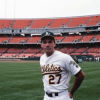
Billy Beane
William Lamar "Billy" Beane IIIis an American former professional baseball player and current front office executive. He is the Executive Vice President of Baseball Operations and minority owner of the Oakland Athletics of Major League Baseball. Prior to his front office career, he played in MLB as an outfielder between 1984 and 1989 for the New York Mets, Minnesota Twins, Detroit Tigers, and Oakland Athletics. He joined the Athletics front office as a scout in 1990. He was named general...
NationalityAmerican
ProfessionBaseball Player
Date of Birth29 March 1962
CityOrlando, FL
CountryUnited States of America
Who wants to get really granular with sabermetrics when you're going to see a two-and-a-half-hour Brad Pitt movie? You don't go to the cinema for a maths lesson.
Deals are always ongoing things. So now, in that respect, Brad is part of the deal. But I'm not the reflective sort when it comes to that kind of thing.
This whole issue didn't sneak up on us. It's disappointing we couldn't come to a conclusion that was satisfactory.
We had a little bit of a logjam (on a one-year deal), and this was a creative way to bring it to a conclusion. We didn't want it to drag on.
Assuming we're healthy, Kenny's not going to have his hands tied very often.
At this point, both sides have agreed to pursue other options. We were just too far apart. I don't think we were ever going to be able to bridge the gap. ... When you're so far apart, there's no sense going through the exercise.
Why do people care about anything we do? We play in a crappy stadium, in a market that we share with another team, with one of the lowest payrolls in the game. Really, I'm not that interesting.
When I first came into baseball, people didn't want to hear that a team was a business. But it is. And the better the business is run, the healthier the team on the field is going to be.
We try to create a situation where we're the casino. It's like how an actuary would set insurance rates. Predictability, predictability, predictability. What's the path to least risk? What's the greater chance of getting some return on this asset?
Trying to build a team over the course of the winter to put on the field is really just half the job. Because if your best players go down, it's not so much him going down as who you replace him with, which ultimately might have the biggest impact on how you end up finishing. So you want to have both a belt and suspenders for support.
The idea that you can create a template that will work forever doesn't happen in any business. There's some really, really bright people in this business. You can't do the same thing the same way and be successful for a long period of time.
Quite frankly, I can't get enough of soccer. I tell my jingoistic friends in the United States there's a reason why it is the world's No. 1 sport. The rest of the planet can't be wrong.
In baseball, you can do something poorly and still get credit. A pitcher could throw a bad ball, the batter hit a screaming line drive, and an outfielder make a fantastic diving catch. Yet, when you look at historical databases, 80% of the time when a ball is struck with that trajectory and velocity, it is a hit.
I've always been intellectually restless, but it is the building part of it that most interests me. It is the constructing of the team that is my favorite part. Anyone who is familiar with the history of the A's franchise, even dating back to Philadelphia, knows that every five or 10 years, you have to tear it apart and rebuild it.