Baruch Spinoza
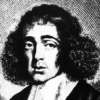
Baruch Spinoza
Baruch Spinozawas a Dutch philosopher of Sephardi/Portuguese origin. By laying the groundwork for the 18th-century Enlightenment and modern biblical criticism, including modern conceptions of the self and the universe, he came to be considered one of the great rationalists of 17th-century philosophy...
NationalityDutch
ProfessionPhilosopher
Date of Birth24 November 1632
men essence desire
Desire is the essence of a man.
desire lines action
I shall consider human actions and desires in exactly the same manner, as though I were concerned with lines, planes and solids.
men desire tongue
Men govern nothing with more difficulty than their tongues, and can moderate their desires more than their words.
men desire wish
Men who are ruled by reason desire nothing for themselves which they would not wish for all mankind.
desire
Desire nothing for yourself, which you do not desire for others.
philosophical ambition desire
Ambition is the immoderate desire for power.
men desire tongue
Surely human affairs would be far happier if the power in men to be silent were the same as that to speak. But experience more than sufficiently teaches that men govern nothing with more difficulty than their tongues, and can moderate their desires more easily than their words.
desire courtesy source
Schisms do not originate in a love of truth, which is a source of courtesy and gentleness, but rather in an inordinate desire for supremacy.
bad good music neither nor time
One and the same thing can at the same time be good, bad, and indifferent, e.g., music is good to the melancholy, bad to those who mourn, and neither good nor bad to the deaf.
bad deaf good music neither nor
Music is good to the melancholy, bad to those who mourn, and neither good nor bad to the deaf
popular religion respect
Popular religion may be summed up as a respect for Ecclesiastes
cannot cause clearly events explained fixed follow human mean merely miracles natural nature ordinary reference relation
As nature preserves a fixed and immutable order; it must clearly follow that miracles are only intelligible as a relation to human opinions, and merely mean events of which the natural cause cannot be explained by a reference to any ordinary occurren
absence mere peace springs state virtue war
For peace is not mere absence of war, but is a virtue that springs from, a state of mind, a disposition for benevolence, confidence, justice.
human nor weep
I have striven not to laugh at human actions, not to weep at them, nor to hate them, but to understand them.