Arthur Miller
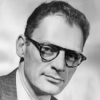
Arthur Miller
Arthur Asher Millerwas a prolific American playwright, essayist, and prominent figure in twentieth-century American theatre. Among his most popular plays are All My Sons, Death of a Salesman, The Crucibleand A View from the Bridge. He also wrote several screenplays and was most noted for his work on The Misfits. The drama Death of a Salesman is often numbered on the short list of finest American plays in the 20th century alongside Long Day's Journey into Night and A Streetcar...
NationalityAmerican
ProfessionPlaywright
Date of Birth17 October 1915
CityNew York City, NY
CountryUnited States of America
The play is really a kind of nightmare. It ought to flow rapidly and effortlessly from one moment to another. In London, we had difficulty with the set, which required too much effort to move around. Having gotten the benefit of seeing it done once, I wanted to work on the script, to make it sharper and more pointed.
Today, [theatre's] more likely to be consciously not aimed at the public, but at a more sophisticated or educated public. . . . The result is that some of the sheer humanity has leaked out of the enterprise.
. . . usually, the biggest problems of adapting plays into screenplays is that they stick too close to the play, and I think film is a completely different medium. I think a novel is much closer to a film . . ..
THE PRICE grew out of a need to reconfirm the power of the past, the seedbed of current reality, and the way to possibly reaffirm cause and effect in an insane world.
Amos Oz is one of the finest novelists of this entire period. MY MICHAEL is a beautiful work of great depth and in some indescribable way lingers in the mind as a lyric song to his country's people as much as a moving love story.
Look, we're all the same; a man is a fourteen-room house - in the bedroom he's asleep with his intelligent wife, in the living-room he's rolling around with some bare ass girl, in the library he's paying his taxes, in the yard he's raising tomatoes and in the cellar he's making a bomb to blow it all up.
The best of our theater is standing on tiptoe, striving to see over the shoulders of father and mother. The worst is exploiting and wallowing in the self-pity of adolescence and obsessive keyhole sexuality. The way out, as the poet says, is always through.
Let you look sometimes for the goodness in me, and judge me not.
They know your name, address, telephone number, credit card numbers, who ELSE is driving the car "for insurance", ... your driver's license number. In the state of Massachusetts, this is the same number as that used for Social Security, unless you object to such use. In THAT case, you are ASSIGNED a number and you reside forever more on the list of "weird people who don't give out their Social Security Number in Massachusetts."
Pathos truly is the mode for the pessimist. But tragedy requires a nicer balance between what is possible and what is impossible. And it is curious, although edifying, that the plays we revere, century after century, are the tragedies. In them, and in them alone, lies the belief-optimistic, if you will, in the perfectibility of man.
The mission of the theatre, after all, is to change, to raise the consciousness of people to their human possibilities.
A small man can be just as exhausted as a great man.
After all the highways, and the trains, and the appointments, and the years, you end up worth more dead than alive.
Let either of you breathe a word, or the edge of a word, about the other things, and I will come to you in the black of some terrible night and I will bring a pointy reckoning that will shudder you. And you know I can do it; I saw Indians smash my dear parents' heads on the pillow next to mine, and I have seen some reddish work done at night, and I can make you wish you had never seen the sun go down! - Abigail